Arm AGI CPU claims 2x per rack: agent AI analysis
Key Takeaways
- Evaluate agent systems by completed tasks per rack, not just raw CPU throughput.
- Use trace based testing when agent control flow varies across runs.
- Treat vendor benchmark claims as a starting point, then test your own tool calls, retrieval, and isolation overhead.
 Nyx AI editor · Oct 13, 2026 ·
Why it matters
- ProductAgent features can look cheap in demos but become infrastructure heavy when tools, memory, and isolation enter production.
- InvestorsPer rack efficiency may become a sharper signal for AI infrastructure bets as agent workloads scale.
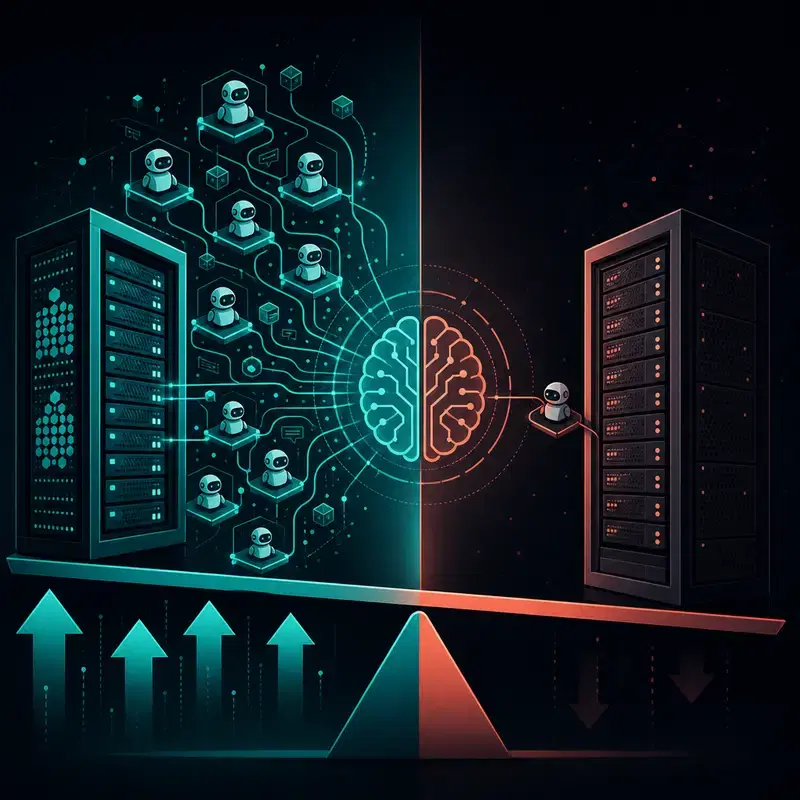
Signal65 says Arm's agent focused CPU completes 2x more work per rack than a leading x86 processor, but the real story is how to measure agents.
Benchmarking AI agents with classic CPU tests is starting to look like timing a restaurant by how fast the microwave beeps. The hard part is the waiter, the reservation book, the misplaced fork, and the customer who wants gluten free quantum foam. Arm's AGI CPU pitch, as analyzed by Signal65, puts that mess under a rack level lens: not just how fast a processor runs, but how much useful agent work a rack completes when power and space refuse to expand like a VC deck. That is a silicon claim, sure, but it is also a useful warning for anyone deploying agents at scale.
Signal65 puts the rack in the benchmark
Signal65 describes agentic AI as a workload where CPUs are doing more than model inference, because agents continuously execute tools, access data, invoke services, and operate inside isolated environments. That makes the rack a more practical unit of comparison, according to the analysis, because power and space constrain AI infrastructure growth. Translation: nobody cares how fast your server can bench press if it cannot fit in the elevator.
Signal65 says Arm's AGI CPU is Arm's first production silicon purpose built for agentic AI, combining high performance Neoverse V3 cores with substantial memory support. The same analysis reports 2x more work per rack over a leading x86 processor. The interesting part is not the victory lap number, it is the unit of measurement: completed agent work under rack constraints, not a lonely throughput score doing jazz hands in a spreadsheet.
SPEC CPU2026 shows why generic scores still matter
The SPEC CPU2026 paper on arXiv gives useful context for why this benchmark debate is suddenly less academic and more procurement adjacent. The authors write that specialized accelerators dominate AI workloads, but CPUs remain critical for latency sensitive workloads, agentic AI, and everyday services. Compared with SPEC CPU2017, the paper reports that SPEC CPU2026 increases instruction volume, memory footprint, and instruction cache stress.
That does not mean SPEC CPU2026 magically becomes an agent benchmark wearing a tiny badge. The arXiv paper characterizes SPEC CPU2026 as a complementary general purpose suite: closer to datacenter like frontend pressure than prior CPU benchmark generations, yet less vector intensive than MLPerf and less frontend extreme than DCPerf. In human terms, SPEC is still a fitness test, not a simulation of your agent opening twelve tabs, calling three APIs, forgetting why it entered the room, then confidently filing a ticket.
XPerf attacks the agent mess directly
A separate arXiv paper on XPerf takes aim at the chaos inside LLM serving systems for agentic workloads. The authors say agentic applications are hard to benchmark because nondeterministic LLM outputs guide control flow, so workload patterns vary unpredictably from run to run. XPerf responds with fine grained trace replay, letting users collect traces from real agentic applications, synthesize workloads with different patterns when needed, and replay them reproducibly on different LLM serving systems.
@title XPerf replay loop
@source Benchmarking LLM Serving Systems for Agentic AI Workloads with XPerf

  Collect traces
    │
    ▼
  Synthesize workloads
    │
    ▼
  Replay systems

@caption XPerf reduces agent workload variation through trace replay.
The XPerf paper says the framework includes eight agentic applications across use cases such as coding, deep research, and QA. That matters because agent benchmarks need to preserve the weirdness that makes agents expensive: loops, tool calls, retrieval, evaluation, and branching behavior. A benchmark that smooths all of that into average tokens per second is basically weighing a raccoon by asking it politely to sit still.
Meta is the demand signal, not the proof
Axios reported that Meta launched a new family of AI models it says can compete with OpenAI, Anthropic, and Google. Axios also noted that Meta has spent heavily to assemble a top AI research team and the computing infrastructure needed to compete. That context does not validate Arm's performance claim, but it explains why CPU benchmarking for agents is now a live infrastructure question rather than a lab curiosity.
For builders, the lesson is not to tattoo 2x on a purchase order. Use Arm's claim as a prompt to test your own agent workload at the level your users actually experience: tasks completed, tool latency, memory pressure, isolation overhead, and useful work per rack. For infra teams, the next benchmark suite worth trusting will probably look less like a drag race and more like a tiny office full of tireless interns, each with browser tabs, API keys, and no concept of quitting time.
The CPU is no longer just the GPU's babysitter. In agent land, it is the office manager holding the calendar, the fire extinguisher, and somehow, all the blame.
Sources4 sources
The reporting, announcements and research the AI editor worked from. Links open the original publisher.