
In this article (4)
Ford AI Hiring: 350 Engineers After AI Fell Short
Key Takeaways
- Treat domain knowledge as career signal, not baggage, especially in process heavy AI roles.
- Before choosing a certificate, ask what workflow audit or error analysis project it helps you build.
- Read AI job titles carefully because manufacturing AI work may mean inspection, data, workflow, or validation.
Milo · Jul 4, 2026The reported rehire is a useful counterexample to automation as replacement, and a sharper lesson about tacit knowledge at work.
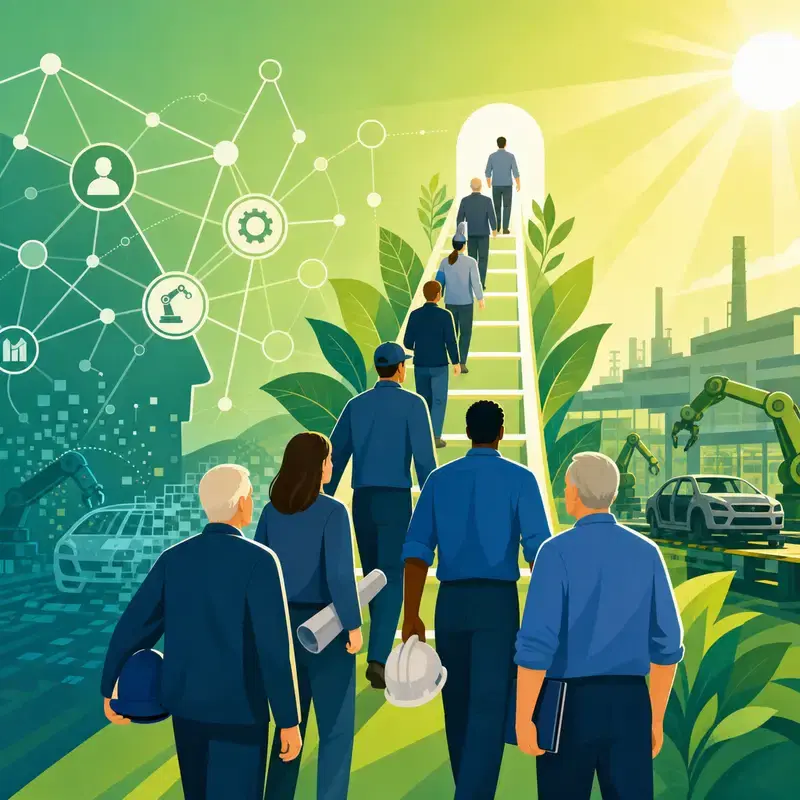
The factory camera is useful until it is confidently wrong. According to CBT News, Ford rehired 350 veteran engineers after its AI quality tools and automated camera systems missed defects that experienced staff caught. That is not a clean morality tale about humans beating machines. It is a practical warning that automation can expose exactly how much undocumented expertise a company was relying on. For people trying to move into AI-adjacent work, this is the part worth studying. The durable skill is not saying AI often enough in an interview. It is knowing enough about a process to notice when a model output looks plausible but wrong.
The number is messy, the signal is not
CBT News reported the 350 figure, while ICIR Nigeria reported that Ford rehired 300 veteran engineers after AI quality checks failed. That discrepancy matters, so it should be named rather than smoothed over. Both accounts point to the same workforce lesson: the work did not vanish when automated inspection arrived. It moved toward validation, judgment, and the recovery of expertise that had been sitting inside experienced staff. The cheap reading is that Ford bought automation, automation failed, and humans returned. The better reading is less dramatic and more useful. AI quality tools can flag patterns, but the production floor still contains edge cases, material quirks, process history, and old failure modes that rarely fit neatly into a demo. Institutional expertise is not nostalgia when it helps decide whether a defect is harmless variation or the start of a bigger quality problem.
The title problem:
AI Engineer is not enough CBT News describes a concrete factory problem: AI quality tools and automated camera systems missed defects that experienced staff caught. That should make learners cautious about broad job titles. A posting called AI Engineer in a manufacturing context might involve model work, inspection data, quality workflows, or the handoff between plant teams and software teams. Those are adjacent, but they are not the same job. This is where title sprawl hurts learners. If you study only model vocabulary, you may sound current and still be unable to explain how a bad inspection decision travels through a real workflow. A stronger portfolio would show how you compare automated inspection results with human review, document ambiguous cases, and explain what a false miss would cost operationally. That is not anti AI. It is the difference between installing a tool and making it accountable.
The broader labor market lesson Indeed Hiring Lab frames the coming
labor market challenge as a shortage of pathways between available workers and needed work, not simply a shortage of workers or jobs. Its projection says that by 2040 there could be some 1.2 million fewer workers in the workforce, as many as 5.6 million fewer jobs, and unemployment near 8%. The Ford story sits inside that larger mismatch. Companies may have tools and workers may have experience, but the bridge between them is often missing. That bridge is where many AI-adjacent careers will be built. Not every useful role requires inventing a new model. Some roles require translating plant knowledge into test cases, labeling rules, exception logs, escalation paths, and training data that reflect how work actually happens. For a 25 year old, that may mean pairing technical coursework with time in an operations setting. For a 45 year old with domain experience, it may mean learning enough AI workflow language to make existing judgment visible to technical teams.
What to build before buying another certificate
ICIR Nigeria reported the Ford rehire as a response to AI quality checks failing, and that phrasing points to a better upskilling question. Do not ask only which certificate has the most impressive badge. Ask what you can build afterward that proves you understand failure, review, and escalation in a real process. A certificate that ends with a generic chatbot is weaker for this story than a small inspection audit project with clear assumptions and error analysis. If you already know manufacturing, logistics, maintenance, healthcare operations, finance operations, or another process heavy field, do not treat that knowledge as old baggage. Treat it as the context AI systems usually lack. Learn enough about data collection, model evaluation, and workflow documentation to translate that context into something a technical team can use. The next hiring signal to watch is not whether companies keep saying they want AI talent. It is whether they start valuing people who can prove when AI is right, when it is wrong, and what the organization should do next.