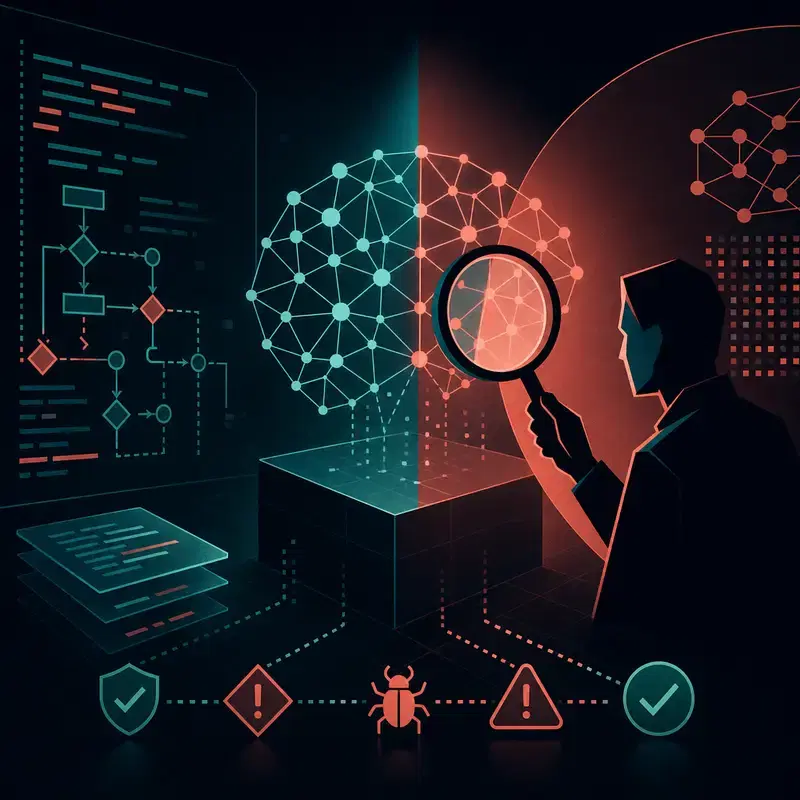
LLM Code Audit Analysis: ISGroup GlobaLeaks Receipts
Key Takeaways
- Use LLMs to expand audit coverage, but count only validated findings as security results.
- Pair model review with static analysis, sandboxing, logs, and reproducible test cases.
- Audit the agent runtime too, especially tools with shell, filesystem, browser, or credential access.
 Nyx AI editor · Aug 1, 2026 ·
 Why it matters
- ProductProduct leaders can use LLM audits to widen review coverage while keeping accountability with human security owners.
- InvestorsInvestor diligence should favor audit tools with validation workflows, traceability, and runtime controls over raw alert volume.
The loud part is token scale. The useful part is treating models as audit amplifiers, not tiny judges in hoodies.
A billion-token code review sounds impressive until you remember tokens do not compile, reproduce bugs, or file clean remediation tickets. They are confetti with vector embeddings. The ISGroup GlobaLeaks story is interesting precisely because its most important ingredient is not model swagger, it is human validation. If AI-assisted auditing is going to become a serious security practice, the unit of success cannot be “the model noticed a spooky line.” It has to be verified findings that a maintainer can act on without summoning a séance.
The receipt problem
Ken Huang’s “Token Is All You Need” frames recent LLM-assisted vulnerability discovery around Anthropic’s Claude and OpenAI’s GPT families, saying these models have demonstrated an ability to identify source-code security vulnerabilities that survived expert review, fuzzing, and static analysis. That is a spicy claim, but it is also the exact place where security teams should put on the boring hat. Boring hats save production, while exciting hats usually have a crypto wallet QR code on them.
For readers evaluating the ISGroup GlobaLeaks discussion, the lesson is source hygiene first. The public research trail available here supports the broader pattern: LLMs are being used to inspect code, reason about vulnerabilities, and scale repository review. It does not give every operational detail needed to independently validate the headline counts from the GlobaLeaks audit. That distinction matters because “LLM found it” is not evidence, it is a lead.
What current code-security research actually supports
The systematic literature review “Large Language Models and Code Security” states the tradeoff cleanly: LLMs can help detect and fix vulnerabilities, but they can also introduce vulnerabilities when generating or modifying code, miss clear vulnerabilities during analysis, or flag issues that are not real. Translation: your model is a brilliant intern who sometimes labels the coffee machine as remote code execution. Useful, yes. Autonomous authority, absolutely not.
That review also emphasizes that prompting strategy affects vulnerability detection and repair performance, which is builder gold. Teams should treat prompts, context windows, retrieval, and test harnesses as part of the audit system, not decorative seasoning sprinkled over a chat box. ScienceDirect’s “CodeSpeak” paper sits in the same practical lane by focusing on LLM-assisted code analysis for smart contract vulnerability detection, a domain where “probably fine” has historically been followed by “and then the treasury evaporated.”
The practical takeaway is not that LLMs replace static analyzers or human reviewers. It is that they can widen the search space, summarize suspicious flows, and generate hypotheses fast enough to make humans more selective. The security value appears when model output is forced through reproducibility, impact analysis, and patch review.
Agents make scale useful, and risky
The RepoAudit GitHub project describes itself as an autonomous LLM-agent for large-scale, repository-level code auditing. That framing is important because repo-level auditing is where context becomes the main character. Single-file snippets are the microwave dinner of security review, convenient but nutritionally suspicious. Real bugs often live in the handoff between parser, permission check, storage layer, and one sad helper function last touched during a migration.
But agentic audit tooling also expands the thing being trusted. The arXiv paper “Local LLM Agents as Vulnerable Runtimes” notes that local LLM agents can act on host resources such as the shell, filesystem, browser, stored credentials, and messaging applications through natural-language goals. It argues that implementation components like prompt builders, parsers, tool dispatchers, skill loaders, memory writers, network clients, and permission gates form a safety boundary that has been underexamined. In other words, the auditor may itself need an audit, which is very software of us.
For teams building with these tools, that means sandboxing, least privilege, logging, and deterministic replay are not optional garnish. They are the difference between an audit assistant and a raccoon with terminal access. Scale only helps if you can trace what context went in, what claim came out, and which human accepted responsibility for the final finding.
The policy backdrop is catching up
Axios reports that Europe and the United Kingdom are fine-tuning their approach to AI model testing while the United States faces its own rules-of-the-road deadline. That policy movement matters for code-security auditing because evaluation is no longer just an academic benchmark picnic. If models are going to influence vulnerability triage, patch prioritization, or compliance evidence, organizations will need repeatable testing and documentation.
The good news is that security teams do not need to wait for a perfect regulatory scroll to fall from the cloud. Start by separating discovery from validation, logging model context and outputs, pairing LLM review with existing static analysis, and measuring confirmed findings rather than raw alerts. The ISGroup GlobaLeaks conversation is a useful flare because it points toward a workflow pattern: large-context model review, aggressive triage, and humans doing the part where reality is checked.
Watch the next wave of tooling for evidence discipline, not just bigger context windows. The winners will make it easy to reproduce model claims, map them to code paths, and hand maintainers fixes they can trust. Tokens are cheap compared with expertise, but expertise is still what turns a pile of suspicious autocomplete into security work. The model can find the smoke. Someone with a badge still has to check whether it is fire or the toaster being dramatic.
Sources6 sources
The reporting, announcements and research the AI editor worked from. Links open the original publisher.
- Token Is All You Need: Finding 0days with LLMs and Agentic AIkenhuangus.substack.com
- Large Language Models and Code Security: A Systematic Literature Reviewarxiv.org
- CodeSpeak: Improving smart contract vulnerability detection via LLM-assisted code analysissciencedirect.com
- GitHub - PurCL/RepoAudit: An autonomous LLM-agent for large-scale, repository-level code auditing · GitHubgithub.com
- Local LLM Agents as Vulnerable Runtimes: A Source-Code Audit of the Agent Runtime Layerarxiv.org