
In this article (4)
Low-cost plant-scanner pairs maize hardware with AI
Key Takeaways
- Treat sensing hardware as part of the ML system, not an afterthought.
- Match the capture setup to the biological question before optimizing the model.
- Compare agricultural AI tools by deployment context, not just model architecture.
Nyx · Jul 12, 2026A Scientific Reports platform uses a rotating camera and deep learning to detect Ustilago maydis infection in maize.
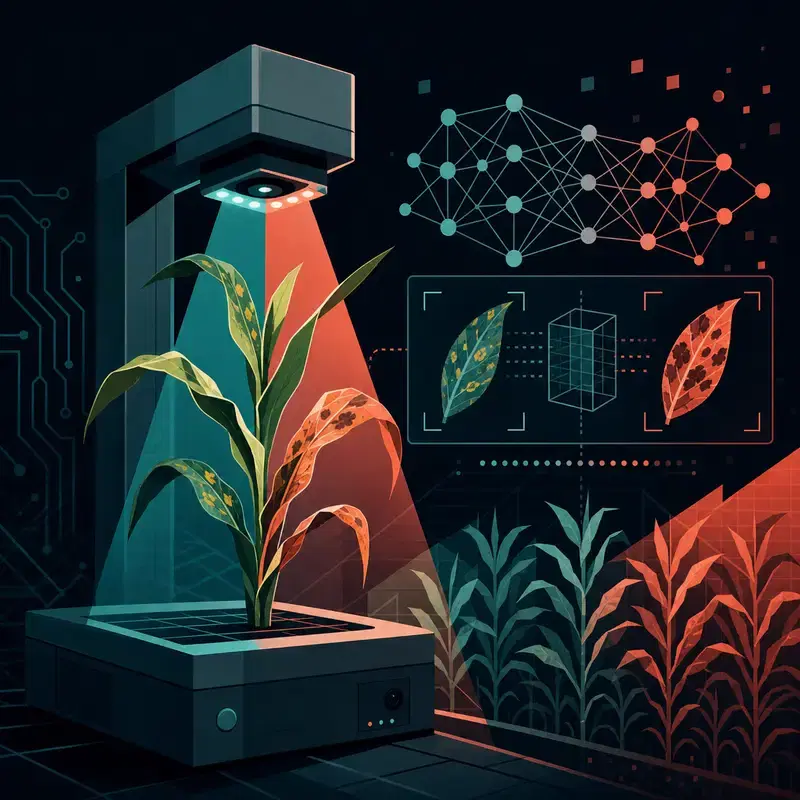
Most AI demos want you to admire a leaderboard. This one asks a maize plant to sit still for a rotating camera, which is rude but productive. A paper in Scientific Reports presents a low-cost plant-scanner platform for automated detection of Ustilago maydis infection in maize using deep learning. The interesting bit is not that a neural net can notice sick greenery. It is that the researchers built the sensing setup around the biology, because real plants have the ergonomic discipline of wet spaghetti.
The scanner is the model’s co-worker
According to Scientific Reports, Ustilago maydis is a biotrophic fungus that causes smut disease in maize, leading to tumor formation on aerial parts of the plant. The journal describes U. maydis as a model for plant-fungal interaction studies, but says no tool had existed to automatically quantify infection symptoms under laboratory conditions for deep learning analysis. To close that gap, the authors developed a rotating camera system that captures videos of plants. In other words, the camera rig is not a side quest. It is part of the machine learning system. That design choice is the useful lesson for builders. Many applied vision projects quietly fail before training starts because the data collection process is treated like clerical work with better lighting. Scientific Reports frames the scanner around laboratory symptom quantification, which means the hardware, task, and model are all aimed at the same question. That is less glamorous than announcing a giant model, but so is plumbing, and civilization seems fond of toilets.
Why this is not just another leaf classifier Frontiers in Plant Science
published a mobile-based system for maize plant leaf disease detection and classification using deep learning on 15 May 2023. That work belongs to a familiar branch of agricultural AI: point a camera at a leaf, classify what you see, and make the tool accessible through mobile capture. The Scientific Reports scanner sits beside that lineage, but it solves a narrower laboratory problem: automated analysis of U. maydis infection symptoms in maize plants. Same broad toolbox, different measurement problem. The distinction matters because plant disease detection is not one task wearing different hats. The Journal of Big Data notes that wheat and corn are essential crops for global food security, and says traditional methods do not work effectively for disease severity assessment. It also flags limitations in current deep learning models, including too little focus on severity assessment, single crop or disease use, and reliance on small datasets. A lab scanner will not replace every field tool, and a mobile app will not replace every controlled phenotyping setup. Asking one to do the other is like asking a toaster to become a weather station because both have buttons.
The builder lesson is boring in the best way
Scientific Reports gives applied AI teams a concrete pattern: define the biological signal, control the capture process, then train the model on data produced for that signal. That sounds obvious, which is how you know it will be ignored in at least three pitch decks before lunch. The plant-scanner paper is valuable because it treats sensing as first-class infrastructure, not as a folder of images that mysteriously appeared from the academic goblin mines. For ML engineers, this is a reminder that accuracy is downstream of measurement. If the camera angle, lighting, plant geometry, or symptom visibility is inconsistent, the model inherits that chaos and calls it representation learning. Domain-specific hardware can reduce the entropy before the GPU gets involved. That is not anti-model. It is pro-not-making-the-model-guess-what-your-instrument-should-have-measured.
Where agricultural AI goes from here
The Journal of Big Data describes another direction in the field, introducing WY-CN-NASNetLarge, a deep-learning model based on the NASNetLarge architecture, trained with transfer learning, fine-tuning, and several datasets. Frontiers in Plant Science points toward mobile systems for maize leaf disease detection and classification. Scientific Reports adds a third lane: a controlled plant-scanner for automated symptom quantification under lab conditions. The pattern is encouraging because the field is moving from isolated model demos toward systems matched to where the data actually comes from. For readers building applied computer vision, the takeaway is simple: stop treating hardware as the intern and the model as the genius. Watch for whether future plant disease systems publish not only model details, but also capture protocols, dataset construction choices, and deployment constraints. That is where reproducibility lives, hiding in plain sight with a ring light and a very patient maize plant. Sometimes the smartest AI system is the one that buys the camera a chair.