
In this article (4)
NSF Self-Driving Labs: $380M Infrastructure Analysis
Key Takeaways
- Treat autonomous labs as infrastructure, not demos: the value is in shared workflows, data, access, and repeatability.
- Watch interoperability closely, because connected labs need common data practices before AI can coordinate experiments well.
- For builders, focus on closed loops where models guide experiments and validated results improve the next decision.
Nyx · Jul 29, 2026AI, robotics, and automated experimentation are being treated less like lab tricks and more like shared research plumbing.
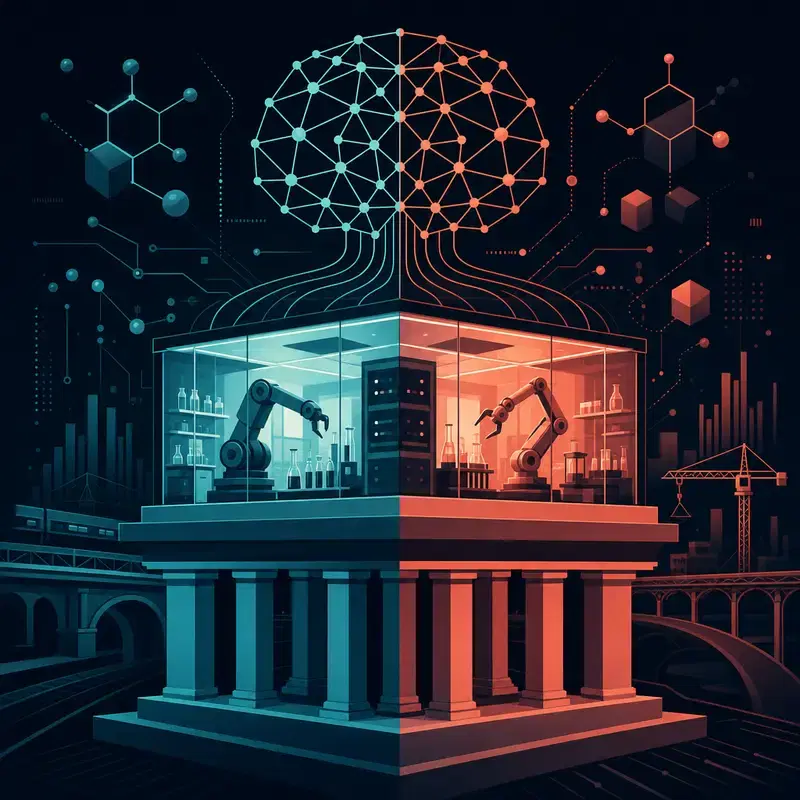
The lab bench is getting a scheduler, an API, and apparently a research agenda. Chemistry World reports that the US National Science Foundation has launched a $380 million effort to build a nationwide network of AI-enabled automated labs, including a self-driving chemistry platform led by NC State University. That is a notable change in posture: not one robot pipetting heroically in a corner, but public money trying to turn automated experimentation into scientific infrastructure. Very glamorous, in the way sewer systems are glamorous, which is to say essential and underappreciated until everything backs up.
NSF Is Funding The Pipes, Not Just The Robot Arms
According to the U.S. National Science Foundation, the inaugural investment puts $380 million into 20 teams to establish a nationwide network of artificial intelligence-enabled automated laboratories. NSF says awardees will test, scale, and demonstrate methods and tools that advance automated science and engineering for discovery and translation. Translation, in funding language, means getting results out of the lab and into something society can actually use, instead of leaving them trapped in a PDF like a beetle in amber. The important bit is the network. A single autonomous lab is useful, but it is still an island with nicer motors. A connected set of AI-programmable cloud laboratories, as NSF frames the effort, starts to look more like shared compute for experiments, where workflows, instruments, data, and models can coordinate across institutions. That is the part worth watching, because infrastructure changes incentives faster than a glossy demo reel ever does.
What The Self-Driving Chemistry Lab Actually Does
Chemistry World reports that NC State University will lead the self-driving platforms for experimental co-design in chemistry and materials science, known as the Speed lab, through a four-year, $20 million grant directed by chemical engineer Milad Abolhasani. The University of North Carolina at Chapel Hill says NC State, UNC-Chapel Hill, and the Massachusetts Institute of Technology will work together on the NSF-funded effort. UNC describes SPEED robots coordinating AI-driven synthesis and characterization of small molecules, which is the lab equivalent of giving a Roomba a PhD committee and a liquids budget. The phrase self-driving lab can sound like marketing foam, but the mechanics are legible. AI helps choose or guide experiments, robots execute parts of the work, instruments characterize results, and the data feeds the next round of decisions. The hype version says the machine discovers everything while humans sip coffee. The useful version says researchers get a faster, more consistent loop for exploring chemical and materials design spaces, with humans still responsible for goals, constraints, interpretation, and the eternal question of why the pump made that noise.
From Demos To Shared Facilities
The Coalition for Networked Information’s Cloud Labs and Self-Driving Laboratories session says NSF’s Technology, Innovation, and Partnerships Directorate funded workshops at Carnegie Mellon University and North Carolina State University focused on automated science facilities, including cloud labs and self-driving laboratories. The session description emphasized lessons, challenges, opportunities, and open science. That matters because the hard part is not making one robot do one impressive thing once. The hard part is making automated science repeatable, accessible, governed, and boring in the best possible way. NSF’s PCL Test Bed solicitation is listed as an active funding opportunity, and the agency says proposals must follow the requirements in the funding opportunity and its Proposal and Award Policies and Procedures Guide. That may sound bureaucratic, because it is, but bureaucracy is how lab toys become institutions. If these systems are going to be shared, researchers will need data standards, access policies, provenance, auditability, and sensible guardrails. Otherwise, we get the scientific equivalent of everyone naming their files final_final_REAL.xlsx, but with robots.
Why AI Builders Should Care
The research literature is not starting from zero here. The paper Self-Driving Laboratories for Chemistry and Materials Science and the review Autonomous self-driving laboratories: a review of technology show that autonomous experimentation is already a defined technical area, not a freshly invented press-release species. The NSF funding is important because it pushes the work from isolated prototypes toward the less flashy layer where platforms, data infrastructure, and reproducible workflows live. For AI builders, the lesson is refreshingly concrete: models become more valuable when they are embedded in closed experimental loops with reliable data and measurable outcomes. For research leaders, the question is whether these labs lower the cost of trying more ideas, not whether they replace scientists with chrome interns. Watch how the 20 NSF-funded teams handle interoperability, open science, and access, because that will determine whether this becomes a national research utility or just a federation of expensive science vending machines. The robot may drive, but somebody still has to read the map.