OpenAI Anthropic Split: Massachusetts AI Safety Analysis
Key Takeaways
- Treat state AI bills as future contract templates, not just political proposals.
- Separate lab obligations from deployer obligations before accepting customer or vendor clauses.
- Watch whether states copy OpenAI's harmonized model or Anthropic's evaluation heavy model.
 Noa · Jul 22, 2026
The Massachusetts fight is less about yes or no on rules than whose compliance architecture other states copy.
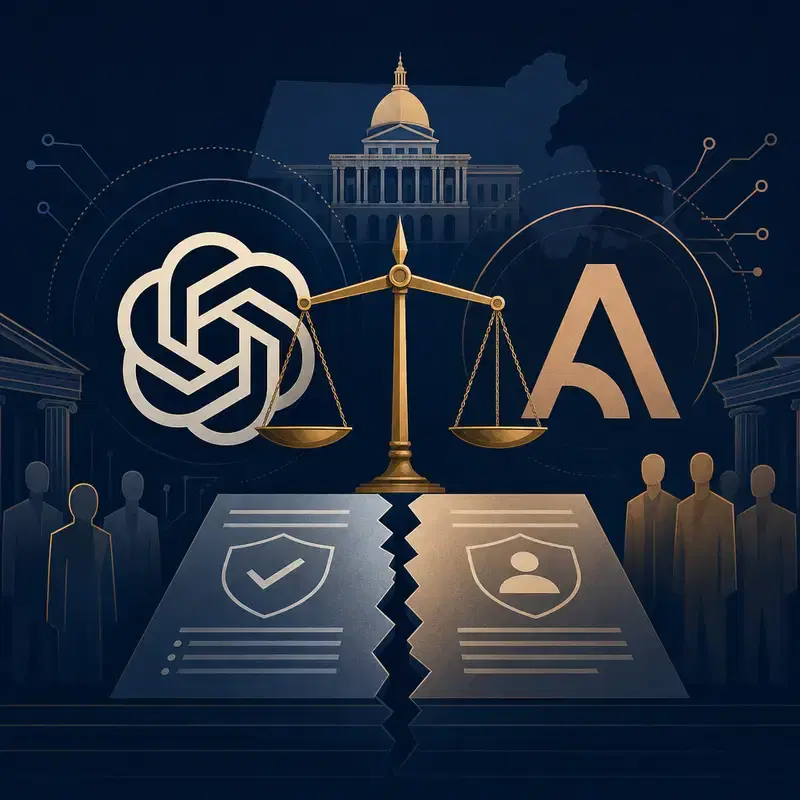
The tell in AI lobbying is no longer whether a lab says it supports regulation. Everyone has learned to say that part. The tell is which spreadsheet it wants regulators to copy, and which obligations it wants competitors to inherit. That is what makes Politico's report on OpenAI backing a narrower Massachusetts AI safety bill worth reading as strategy, not theater. OpenAI and Anthropic are not simply standing on opposite sides of regulation. They are competing over the default operating model for frontier AI compliance.
The bill is also a product spec
Politico reports that OpenAI is backing a narrower Massachusetts AI safety bill, which matters because state AI bills increasingly read like procurement requirements with a legislative cover page. BillTrack50 identifies MA S2630 as a bill for promoting economic development with emerging artificial intelligence models and safety, introduced on 10/16/2025 and sent to committee the same day. Its summary says the bill would create the Massachusetts Artificial Intelligence Innovation Trust Fund and the Transparency in Frontier Artificial Intelligence Act. The operative compliance phrase in BillTrack50's summary is not the fund. It is the requirement for large AI developers, described there as developers with annual revenues over $500 million, to develop and publish a frontier AI framework for assessing and mitigating potential catastrophic risks. In plain English: if you are in scope, the paperwork is not decorative. Your safety framework becomes an external promise, and your vendor contracts will need to know who owns risk assessment, publication review, incident escalation, and evidence retention.
Two labs, two compliance defaults
AI News Weekly, summarizing Politico's reporting, frames Anthropic as endorsing California's SB 53, New York's RAISE Act, an Illinois third party audit bill, and a Massachusetts frontier AI transparency measure. The same account says the Massachusetts proposal covers labs with over $500M in AI derived revenue or $1B in AI R&D, and would require independent risk evaluations at least every six months. That is a very different default from a lighter framework that emphasizes alignment among state laws. OpenAI's contrasting play is described by AI News Weekly as reverse federalism, attributed to OpenAI global affairs chief Chris Lehane: pushing blue states to mirror each other's AI laws rather than waiting for a federal one. Translation for builders: the fight is over whether your compliance program becomes a recurring external evaluation cycle, or a harmonized state reporting package that can be reused across jurisdictions. One is operationally heavier. The other is administratively neater, assuming states actually copy each other, which is the part lawyers will underline twice.
Liability is the quiet prize
WIRED's Maxwell Zeff reported a related OpenAI move in Illinois, where the company supported SB 3444, a bill that would limit when frontier AI developers could be liable for critical harms caused by their models. WIRED says those harms include death or serious injury of 100 or more people, or at least $1 billion in property damage. The bill would shield developers if they did not intentionally or recklessly cause the incident and had published safety, security, and transparency reports on their websites, according to WIRED. That is not anti regulation in the simple bumper sticker sense. It is regulation with a liability architecture attached. Publish the right reports, avoid intentional or reckless conduct, and the legal exposure changes. Compliance teams should notice the bargain being offered: process becomes both a safety control and a litigation shield. When a company says it welcomes clearer rules, read the footnotes before nodding.
What builders should do now
WWLP reported that Massachusetts voters are paying attention, citing a poll in which 65% of voters were more concerned about AI dangers, compared with 16% excited about potential uses, and 75% supported requiring AI developers to assess risk and publish safety plans. That public backdrop matters because legislators can move faster when the polling file is friendly. It does not mean every app builder is suddenly a frontier lab, but it does mean downstream buyers will start asking frontier style questions. For product and compliance teams, the practical move is boring and useful: map which obligations attach to the model developer, the deployer, and the customer before a state bill becomes the template your largest customer uses. If you buy frontier models, ask vendors for their published safety framework, evaluation cadence, report update process, and incident notice language. If you build on top, do not volunteer to own obligations that the statute places on the lab unless your pricing model includes a line item for being their unpaid compliance department. The next thing to watch is not who claims to be pro safety this week. Watch which Massachusetts language survives amendment, whether Anthropic's evaluation heavy model or OpenAI's harmonization model travels to the next state, and how quickly enterprise contracts start reflecting it. The law may not be enforceable yet, but procurement departments rarely wait for the first fine to discover a new questionnaire.