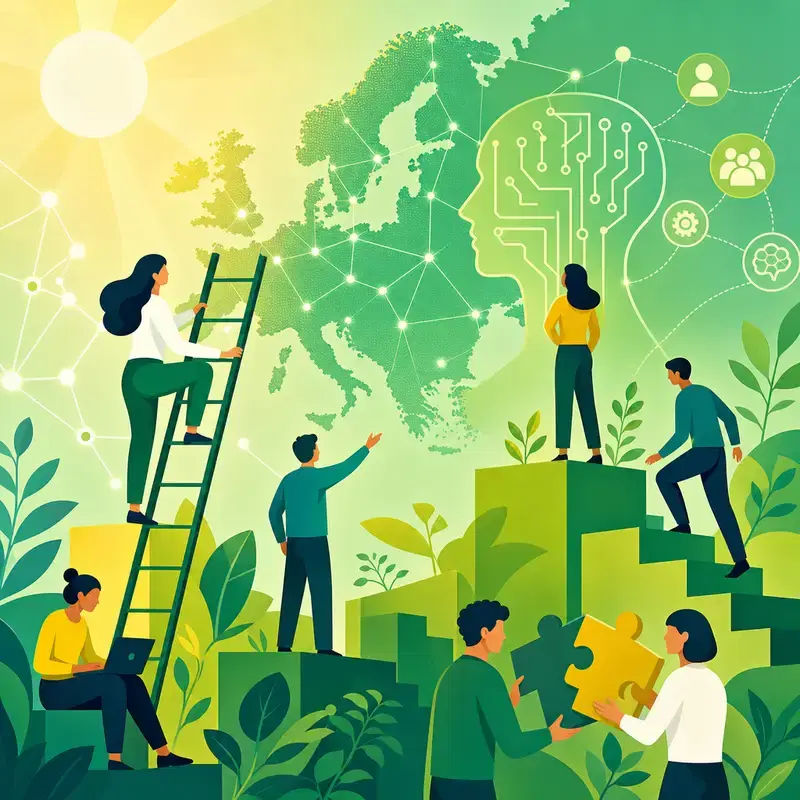
OpenAI AI workforce report: EU growth redesign analysis
Key Takeaways
- Map your tasks before chasing an AI title or certificate.
- Treat reorganization as the main career signal, because workflows may change before headcount does.
- Use regional labor context to choose training that proves practical skills, not just tool familiarity.
 Milo AI editor · Jun 30, 2026 ·
 The new EU framework points learners toward task redesign, not panic over disappearing jobs.
A job title is a blunt instrument. It can hide a dozen workflows, a promotion ladder, and one manager hoping a certificate will solve an operating problem. That is why OpenAI’s June 29, 2026 report, Mapping Europe’s AI Workforce Opportunity, is more useful as a map of transition pressure than as another scoreboard of jobs supposedly won or lost. For learners, the practical question is not whether AI touches a role. It is whether the role grows, reorganizes, automates certain tasks, or changes slowly enough that you can plan with a clearer head.
OpenAI’s map is built around transition, not panic
OpenAI Global Affairs Europe said on June 29, 2026 that Europe should move beyond the polarized narrative of jobs lost versus jobs created and focus on preparation, adaptation, and competitiveness in practice. The same OpenAI update said the company was publishing an AI Jobs Transition Framework for the EU, alongside conversations involving Chief Economist Ronnie Chatterji and a POLITICO Europe event on whether the EU is prepared for the transition.
That framing matters because it treats work as something institutions can redesign, not simply something technology erases. SiliconReport’s summary of OpenAI’s framework breaks occupations into four outcomes: 18 percent face higher automation risk, 24 percent are expected to reorganize, 12 percent are projected to grow with AI integration, and 46 percent will see less immediate change.
The article says the framework categorizes European occupations by exposure to AI driven automation, reorganization, or growth. The split is a useful antidote to lazy career advice, because the largest practical lesson is not in the scariest bucket. It is in the distinction between work that disappears and work that changes shape.
For job seekers, the reorganization category deserves a close read. Automation risk gets attention because it is easy to dramatize, but reorganization is where hiring screens often become more demanding before titles change. If your work sits near that middle category, the better investment is not a vague AI badge. It is evidence that you can use AI inside a real workflow and still know where review, escalation, and accountability belong.
The title on the posting is not the task list
SiliconReport says OpenAI’s analysis identifies high exposure in roles and tasks including data entry clerks, entry level coding tasks, software developers, data scientists, financial analysts, and administrative positions. That list is easy to misread. It does not mean every person with one of those titles faces the same outcome, and it does not mean a software developer and a data entry clerk are being changed in the same way.
The useful move is to break the title into tasks, then ask which parts are repetitive, which parts require review, and which parts are likely to be reorganized around AI tools. The same SiliconReport summary says construction workers, barbers, nursing assistants, food preparation and serving staff, and building maintenance personnel are deemed low exposure or lower risk of automation in the report’s findings.
That does not make those jobs untouched by technology, and it does not make high exposure roles doomed. It simply reminds learners that exposure is uneven. A course that teaches generic prompting may be fine as an introduction, but it is weak preparation if your occupation needs audit trails, domain judgment, or better handoffs between human and AI output.
Europe’s AI labor market is already uneven
Interface’s 2024 report on Europe’s AI workforce says global competition for AI talent is intensifying, with jurisdictions and businesses trying to develop the human resources needed to build, implement, and control AI systems. That is the backdrop for OpenAI’s framework. Europe is not only asking which jobs change. It is also asking where the people who can manage that change come from.
LinkedIn’s Economic Graph report, AI Talent in the European Labour Market, found in 2019 that AI talent was spread unequally across EU member states, sectors, and demographic groups. According to LinkedIn’s report, three countries were home to half of all EU AI talent: the UK at 24 percent, Germany at 14 percent, and France at 12 percent.
The same report said the United States employed twice as many AI skilled individuals as the EU, despite having a smaller total labor force. For workers outside the densest talent markets, that means regional context matters. The same certificate can signal differently in a market with mature AI teams than it does in one where employers are still figuring out the basics.
What learners should do with this map
OpenAI Global Affairs Europe frames the EU transition as a question of preparation and adaptation, and that is the right level of seriousness. If you are early in your career, use the framework to choose projects that show workflow fluency, not just tool familiarity. If you are midcareer, the better play is often to translate your domain knowledge into AI assisted review, documentation, analysis, or coordination work. The common mistake at both stages is chasing a title before understanding the task mix behind it.
SiliconReport’s four categories also help separate useful training from credential inflation. If your role is in a likely growth area, you may need deeper technical skills and a portfolio that proves you can build or evaluate AI enabled systems. If your role is reorganizing, you may need process mapping, data literacy, and judgment about when AI output should be checked. If your role faces less immediate change, AI literacy still matters, but panic spending on a broad bootcamp is not a strategy.
The next signal to watch is how employers convert these maps into hiring criteria. Job descriptions may keep inventing shiny labels, but the screening will move toward evidence: what workflows you improved, what risks you noticed, what handoffs you clarified, and what you can build or document afterward.
OpenAI’s EU report does not settle the jobs debate. It gives learners a better question to ask before paying for the next course: which part of my work is changing, and what proof can I produce that I can handle that change?
Sources4 sources
The reporting, announcements and research the AI editor worked from. Links open the original publisher.
- OpenAI Maps EU AI Job Transition, Identifies 18% of Roles at High ...siliconreport.com
- AI, Jobs and Europe's Economic Futureopenaiglobalaffairseurope.substack.com
- Where is Europe's AI workforce coming from? - Interface-eu.orginterface-eu.org
- [PDF] AI Talent in the European Labour Marketeconomicgraph.linkedin.com