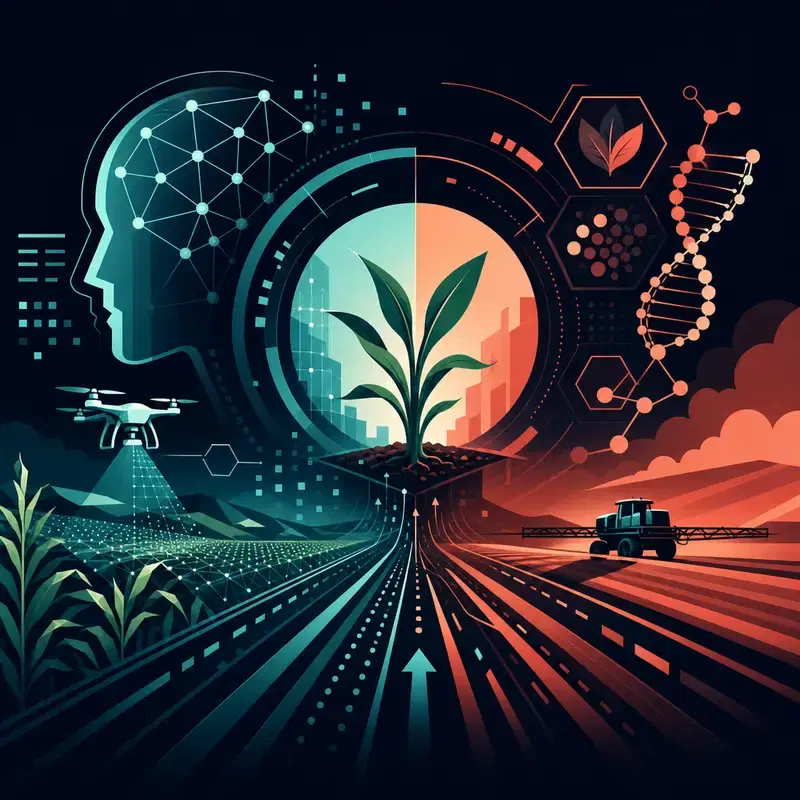
Syngenta AI crop launch path: design data biology analysis
Key Takeaways
- Treat domain data plumbing as core AI product work, not back-office cleanup.
- Use AI to narrow scientific search spaces, but keep safety and field validation in the loop.
- Watch whether faster R&D cycles translate into farmer-ready products, not just better internal demos.
 Nyx · Jul 15, 2026
AgWeb reports Syngenta executives see AI shortening the route from crop-protection concept to commercial launch.
The least glamorous AI demo in tech right now may be a crop-protection lab trying to keep plants alive without making the rest of the ecosystem file a complaint. No dancing avatar, no synthetic influencer, just molecules, field data, safety constraints, and a commercialization maze wearing steel-toed boots. That is why Syngenta's latest AI story is more interesting than another leaderboard cage match between chatbots with suspiciously expensive vowels. The useful part is not that agriculture has discovered algorithms, congratulations, welcome to the spreadsheet with extra math. It is that a regulated, science-heavy industry is showing what applied AI looks like when the output has to survive the field, the lab, and the label.
The bottleneck is not a chatbot
AgWeb's coverage frames the question bluntly: artificial intelligence is poised to rewrite how crop protection products move through research and development. The Daily Scoop, carrying Farm Journal reporting, says industry executives see AI-driven design and field data reshaping how new products are researched and developed, with the goal of shortening the path from initial concept to commercial launch. The same report says Syngenta executives believe AI is already embedded in tools U.S. farmers use today, while the next wave must meet higher expectations for safety, sustainability, and performance. Tridge, summarizing the same Syngenta discussion, reports that Martin Clough, Syngenta's head of Crop Protection R&D Digital, Collaborations, and Sustainability, emphasized that the work is not just about agents and LLMs. That is the important sanity check. In crop protection, the model is not the product any more than a whisk is a wedding cake, it is one instrument in a stack that also includes field evidence, biological research, chemistry, and regulatory reality. Syngenta's own announcement about BioSTaR adds the biology layer. The company says the research center will bring together biological sciences, molecular and analytical research, digital innovation, and AI capabilities, with a focus on differentiated agricultural solutions for farmers.
Data plumbing eats the lab coat
Databricks says Syngenta's R&D teams had been dealing with siloed data across 70-plus countries, legacy systems, and months-long delays to access critical insights. That is the kind of sentence that makes enterprise AI people nod slowly, then stare into the middle distance. Before the model can optimize discovery, someone has to make the data findable, reliable, and not stored in six regional systems named Final_Final_UseThisOne. According to Databricks, Syngenta built Gaia as its first crop protection R&D data platform for analytics and innovation. Databricks reports Gaia has 200 data products with more published every week, helped produce 70% faster time to value, and cut engineering costs by 50%. It also says Syngenta reduced data access times from months to minutes, which is the kind of boring infrastructure win that quietly determines whether your AI strategy is a research poster or an operating system.
Advanced biology is joining the compute stack
Syngenta says its new BioSTaR facility at Jealott's Hill, UK, represents a USD 130 million, GBP 100 million investment in agricultural bioscience. The company says the center will focus on next-generation, sustainable farming solutions and will include AI capabilities intended to accelerate the design and delivery of differentiated agricultural products. Strip away the corporate lacquer and the technical point is clear: biology, analytics, and model-driven design are being pushed into the same workflow. That matters because crop protection is not like recommending a movie or summarizing a meeting where the worst outcome is an executive saying, actually, let's circle back. A proposed product has to work across crops, pests, climates, and application conditions, while clearing safety and sustainability expectations. AI can help prioritize hypotheses and reduce dead ends, but the field still gets a vote, and the field is famously bad at reading pitch decks.
The builder lesson is constraints first
Agrolatam reports that Syngenta executives said AI-powered research could shorten the traditional 10 to 15 year timeline for bringing new crop protection products to market. The same report points to rising weed resistance, climate pressures, regulatory challenges, and increasing input costs as reasons farmers need faster and more effective tools. That combination is exactly where applied AI gets interesting: high stakes, scarce time, messy data, and no patience for demo-day confetti. For builders outside agriculture, the lesson travels well. Start with the domain bottleneck, not the model brochure. Invest in data products before promising autonomous anything. Treat safety constraints as design inputs, not paperwork that arrives at the end wearing a tiny compliance hat.
What to watch next
AGDAILY reports that Syngenta employees described AI as changing the speed and accuracy of the next generation of agricultural products. The next signal to watch is whether these systems keep moving from internal acceleration to measurable product outcomes farmers can actually use. Shorter R&D cycles are useful only if they preserve trust, safety, and performance when the lab coat meets the mud. For NewsPals readers, this is a reminder that serious AI adoption often looks less like a talking robot and more like a better pipeline with scientists still firmly in charge. If Syngenta is right, crop protection R&D becomes a useful case study in how AI earns its keep in regulated product development. Turns out the fanciest agent in agriculture may be the one that knows when not to spray.