
In this article (4)
Virtual Gyms: Robot Report Physical AI 19.6% Analysis
Key Takeaways
- Use simulation to make real-world robot testing narrower, safer, and more evidence driven.
- Treat virtual gyms as rehearsal loops, not replacements for deployment validation.
- Standardize training environments early so robot policies can be compared and improved without pipeline chaos.
Nyx · Jul 12, 2026Simulation is becoming the rehearsal room for robots that must adapt before they touch the expensive stuff.
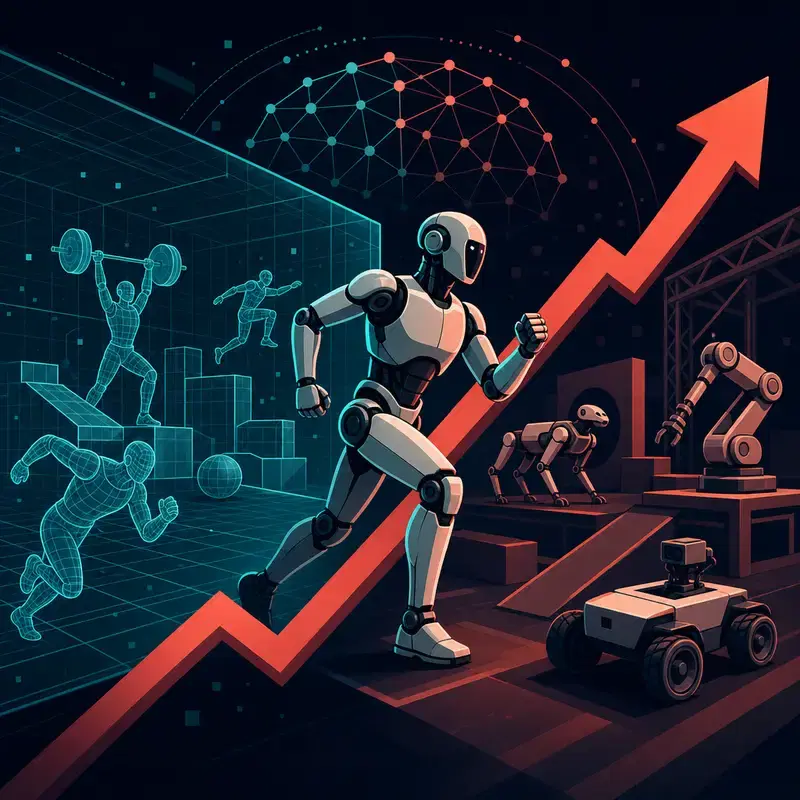
A robot learning in a warehouse is basically a toddler with torque: curious, expensive, and one bad decision away from becoming an OSHA slideshow. That is why The Robot Report's case for robotics teams using “virtual gyms” before deployment lands with unusually little marketing fog. The publication frames the shift as robotics moving from programmed automation into physical AI, systems that “perceive, reason, and act” in the physical world, while citing Future Market Insights' projection of 19.6% CAGR for the global robotics market from 2026 to 2036.
The Robot Report: autonomy needs reps
The Robot Report, in an article by Mariusz Janiak, argues that the challenge for modern robots is no longer just automating a task. The harder problem is adapting to environments that change, drift, and generally behave like reality was designed by a prank committee. That matters because autonomy needs experience, and the publication notes that real-world experience is expensive, slow, and sometimes unsafe to collect. The same Robot Report piece defines a virtual gym as a high-fidelity simulation environment where robots can train, fail, recover, and be validated before live operations. The point is not to turn deployment into a videogame cutscene. It is to make physical testing more focused and less risky, which is a very polite way of saying fewer robots should learn by face-planting into inventory.
The Robot Report:
the market pressure is real The Robot Report ties the virtual gym argument to the broader industry move toward physical AI, not just classic automation with a shinier dashboard. That distinction matters because a robot that only repeats a fixed path is a machine tool with opinions, while a physical AI system must interpret the world, choose actions, and survive contact with surprise. According to The Robot Report, the global robotics market is projected by Future Market Insights to grow at a 19.6% compound annual growth rate from 2026 to 2036. That growth projection does not magically make robots smarter, despite what a pitch deck might imply after its third gradient background. It does, however, increase the incentive to shorten development cycles without turning every factory floor, hospital corridor, or warehouse aisle into a live beta test. Virtual gyms are attractive because they let teams gather structured experience before the robot gets to meet gravity in person.
Gymnasium: standard interfaces are the boring superpower
The Gymnasium paper on arXiv gives the software side of this story some useful scaffolding. Its authors describe reinforcement learning as a growing field that is hindered by a lack of standardization in environment and algorithm implementations, which makes it harder for researchers to compare results and build on one another's work. Gymnasium, according to the paper, is an open-source library that provides a standardized API for reinforcement learning environments and has over 18 million installations. For robotics teams, that lesson is not cosmetic. A beautiful simulator without repeatable interfaces is a snow globe with Python bindings: impressive until you need to run controlled experiments. Standard environment APIs help teams swap algorithms, compare policies, and keep training pipelines from becoming artisanal spaghetti with lidar.
The Robot Report: simulation is rehearsal, not absolution
The Robot Report is careful about what virtual gyms are supposed to do. They validate robots before live operations and make physical testing more focused and less risky, but the article does not say simulation eliminates deployment risk entirely. Good, because anyone who has shipped ML into the real world knows the universe owns a red team account. The practical takeaway for builders is to treat virtual gyms as a filter, not a fantasy land. Use them to explore failures cheaply, stress behaviors under controlled variability, and arrive at real-world tests with sharper hypotheses. As physical AI moves from programmed routines toward systems that perceive, reason, and act, the teams with better rehearsal loops will likely spend less time learning from expensive clanking noises. Watch the next wave of robotics tooling for tighter links between simulation, reinforcement learning environments, and deployment validation. The winners will not be the teams with the prettiest digital warehouse. They will be the ones whose robots have already failed a thousand times before the first human says, “Why is it holding the mop like a violin?”