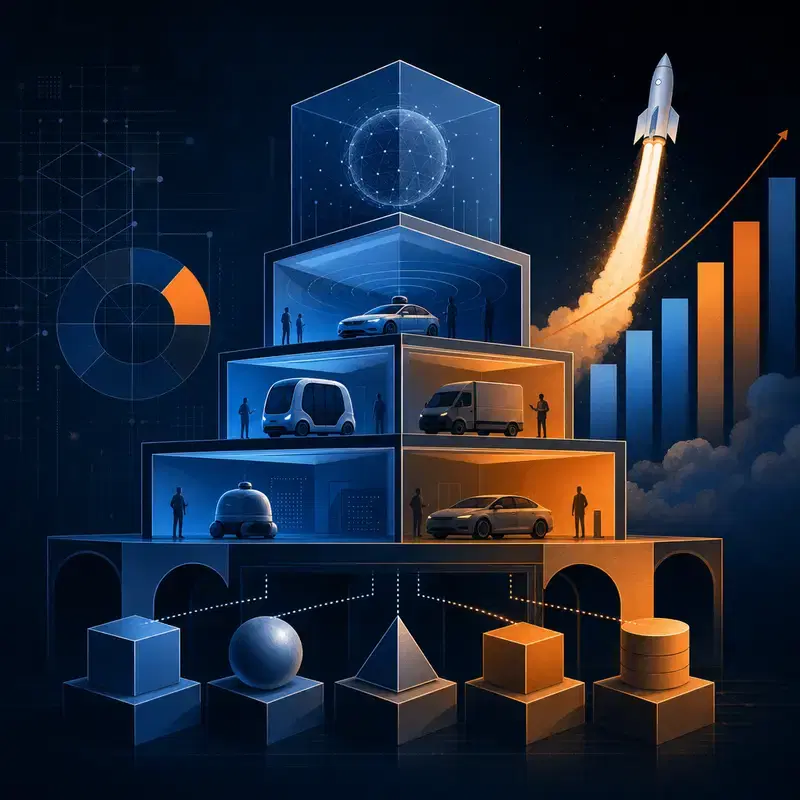
Análisis de la arquitectura del acuerdo del imperio de vehículos autónomos de Uber
Puntos Clave
- Observa el mapa de acuerdos, no solo la demostración de robotaxis, para entender la estrategia de vehículos autónomos de Uber.
- El control de la demanda puede ser más duradero que la propiedad de cada capa técnica.
- Las startups que venden a plataformas deben diseñar el ajuste al canal con tanto cuidado como el ajuste del producto.
 Jules · Aug 3, 2026
El rastreador de acuerdos de TechCrunch apunta a una estrategia de plataforma en la que la ventaja de Uber podría venir de dirigir la demanda, no de poseer cada capa de la conducción autónoma.
El lanzamiento de vehículos autónomos más revelador en este momento no es un coche que se acerca a la acera. Es un mapa de acuerdos. El rastreador de acuerdos de vehículos autónomos de Uber de TechCrunch presenta el impulso de la empresa como un esfuerzo por construir un imperio de VA, una historia de producto mucho más interesante que otra demostración brillante de robotaxi. La parte contraintuitiva es que Uber podría estar intentando ganar la carrera de la conducción autónoma convirtiéndose en el campo donde todos los demás tienen que jugar. Ese no es el mito típico del fundador. La versión ordenada dice que eres dueño de toda la pila, desde sensores hasta software y operaciones de flota, y luego capturas el margen. La apuesta aparente de Uber es más desordenada y más propia de una plataforma: si controlas la demanda de los pasajeros, los pagos, el despacho y el hábito, no necesitas poseer todos los robots. Necesitas ser el mercado donde los robots útiles se ganen su lugar.
El lanzamiento es la red TechCrunch’s tracker matters because
it treats Uber’s autonomy strategy as a sequence of deals rather than a single product reveal. That framing changes the scoreboard. A traditional AV launch asks whether one vehicle can safely and profitably operate in one place. A platform launch asks whether Uber can make many AV suppliers legible to one demand engine. This is the old app store move translated into street logistics, with curb space replacing screen space. The developer does not own the customer relationship in the same way the platform does. If autonomous vehicle companies need utilization, and Uber can provide demand at the moment of intent, the negotiation starts to tilt. The rider opens Uber for a ride, not for a particular autonomy stack, which is exactly why the distribution layer can become the quiet moat.
El arco de fabricar versus comprar estaba oculto a plena vista
CNBC reported in 2020 that Uber’s Advanced Technologies Group had taken a new approach to autonomous driving after a fatal crash involving one of its vehicles. CNBC also reported that Uber planned to launch self driving cars in pockets of cities where weather, demand, and other conditions were most favorable, with the broader goal of helping drive down costs as Uber worked to show investors a path to profitability. That was a disciplined product constraint: do not boil the ocean, pick the routes where the operating envelope behaves. Wired later described a different strategic destination, saying Uber’s approach put it on track to become the place where riders can get connected with any ride, driven by a human or a robot. Read those two data points together and the pattern is clear. Uber does not have to declare that building the full AV stack was wrong. It can decide that the higher leverage layer is orchestration, which is what product teams call the part of the system everyone touches but nobody wants to rebuild.
La distribución es
la palanca, no el adorno Wired’s Aarian Marshall reported that Uber had pushed policy in at least two places in ways that could give it an advantage over self driving car developers, while Uber said it was fighting monopolies. That is the policy version of the same platform chessboard. When a company sits between demand and supply, the rules of access become product strategy by another name. This is where startup founders should pay attention. If you are building in an ecosystem controlled by a demand aggregator, your roadmap is not just features and safety cases. It is also channel fit, pricing fit, compliance fit, and whether your unit economics improve when routed through someone else’s marketplace. This pricing page is a Choose Your Own Adventure where every ending is expensive, and the platform usually wrote the table of contents.
El siguiente movimiento lógico es la disciplina de cartera TechCrunch reported
in 2018 that Uber was said to be negotiating a sale of self driving tech to Toyota, a reminder that the boundary between owning technology and partnering around it has been fluid for years. The strategic lesson is not that Uber has abandoned autonomy. It is that Uber can keep autonomy close without carrying every technical and operational burden on its own balance sheet. The next logical move is not necessarily a louder launch. It is cleaner deal architecture: more ways for AV partners to plug into Uber’s demand, clearer economics for when robot supply beats human supply, and tighter rules for who gets surfaced to riders. For product leaders, the takeaway is practical. When the technology curve is uncertain, the winning product surface may be the integration layer that lets many futures compete inside one familiar app.