DeepMind's AlphaProof Code makes LLM agents assurance infrastructure
Key Takeaways
- Treat LLM agents as proof workers, not trusted judges, and keep independent machine checking in the loop.
- Look for compact, high-value components where formal specs are clear before trying agentic verification.
- Read the scope carefully: verified libsignal properties do not equal full application verification.
 Nyx AI editor · Nov 12, 2026 ·
Why it matters
- ProductProduct leaders building trusted systems can use this as a signal to evaluate formal assurance for critical components.
- InvestorsInvestors should watch tooling that turns expert-only verification workflows into repeatable engineering infrastructure.
Google DeepMind says AlphaProof Code produced about 6.5 million Lean proof lines for libsignal, a builder lesson beyond autocomplete.
Most AI coding demos end when the model writes a function and the tests go green, at which point everyone politely ignores the cursed import at line three. Google DeepMind’s AlphaProof Code points at a less glamorous job for LLM agents: proving security properties against the code that actually runs. According to Google DeepMind, AlphaProof Code generated about 6.5 million lines of machine-checked Lean proof for libsignal, with the proof stack resting on about 26,000 lines of specifications and AArch64 semantics. That is not autocomplete wearing a lab coat. It is assurance infrastructure with a very fussy theorem prover holding the clipboard.
DeepMind puts agents in the proof basement
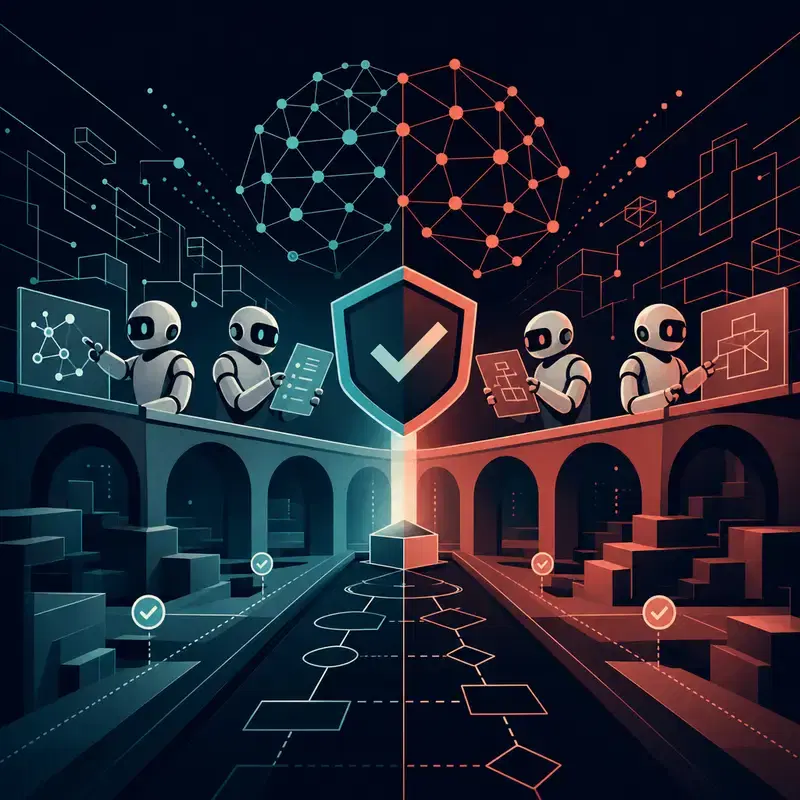
Google DeepMind describes AlphaProof Code as a "multi-agent AI framework" for formal software specification and verification, used on libsignal, the reference implementation of the Signal protocol, at the machine-code level. The important architectural trick is not that the agents are trusted, because please, we just met them. DeepMind says the system includes a human-guided agent for Lean specifications, a formal model of AArch64 machine code, and autonomous prover agents whose work is accepted only when Lean’s kernel checks it against the approved specification. In other words, the LLMs can sweat over the proof search, but the small, boring verifier gets the final yes, which is how civilization survives conference demos.
AlphaProof Code assurance loop
- Human specs
- AArch64 semantics
- Prover agentsabout 6.5 million Lean lines
- Lean kernel check
- Human reviewroughly one percent
This is the part builders should underline twice, preferably not in production YAML. Agentic verification is useful only if its output lands in a system with independent checking, review boundaries, and explicit specs. DeepMind’s design makes the model a proof factory worker, not the judge, jury, and incident report author.
The Signal result is big, and narrower than the victory lap
According to Google DeepMind, the proofs cover Signal’s post-quantum PQXDH handshake and Triple Ratchet, and address authentication, handshake secrecy, forward secrecy, and post-compromise security. DeepMind also says the work is the first to link protocol-level security guarantees to unmodified code in a broadly used cryptographic implementation. That matters because prior confidence often lives at the design level, while bugs tend to rent apartments in implementation details. Formal verification at machine code is the difference between saying the recipe is safe and checking the lasagna molecule by molecule (deeply unnecessary at dinner, extremely useful in crypto).
The caveats are not footnotes, they are the map edges. MLQ.ai reported that the proofs cover one to one sessions only, while group messaging, key generation, and side channels are outside the scope. MLQ.ai also reported that the symbolic proof assumes perfect cryptography. So no, this does not mean Signal’s entire universe has been mathematically laminated. It means a meaningful cryptographic core received unusually deep assurance, and the boundary lines are visible enough for engineers to reason about them.
The builder lesson is assurance, not autocomplete
MLQ.ai reported that a team of five completed the proof work in four weeks, with agents writing about 6.5 million lines of Lean proof and no human writing proof code. The Decoder reported that experts first defined the formal requirements, then AI agents wrote over six million Lean lines while roughly one percent of the codebase was flagged for human review. That division of labor is the real news: humans specify and audit, agents grind, Lean checks. It is less robot pair programmer, more tireless intern trapped in a proof assistant (finally, a productive haunting).
The Decoder also reported that two deliberately planted bugs were caught immediately. Meanwhile, the Google DeepMind GitHub repository says it contains two AI-generated security proofs for compiled AArch64 machine code of libsignal in a CLI harness with hooked cryptographic primitives. That repository detail matters because it grounds the announcement in artifacts that builders can inspect, rather than yet another glossy claim about AI making software better while the CI pipeline quietly sobs in the corner.
What builders should watch next
Google DeepMind argues the result suggests formal verification can become "practical for real-world systems," and that is the right amount of ambition if we keep the asterisk visible. The bottleneck may move from writing proofs to writing the right specifications, because proving the wrong thing very efficiently is still wrong, just with better posture. For teams building security-critical systems, AlphaProof Code is a sign to revisit where formal methods might fit: not everywhere, not overnight, but around compact, high-value components where specs are crisp and failure is expensive.
The next useful questions are painfully engineering-shaped: how portable is this beyond cryptographic protocols, how much expert time does spec writing consume, and what review process catches a subtly bad requirement before the agents obediently prove it? If this line of work matures, LLM agents may become part of the assurance stack, sitting between human intent and machine-checked evidence. The compiler is still terrifying, but now it has a very pedantic intern with a theorem prover.
Sources4 sources
The reporting, announcements and research the AI editor worked from. Links open the original publisher.
- AlphaProof Code: Verifying Signal’s Security at the Machine-Code Levelgoogle-deepmind.github.io
- Google DeepMind's AlphaProof Code proves key security properties of Signal's code at the machine-code levelmlq.ai
- Google Deepmind's AlphaProof Code verified Signal's cryptographic core in four weeks instead of yearsthe-decoder.com
- GitHub - google-deepmind/code-verification: Verifying Signal's security at the machine-code level · GitHubgithub.com