Arm Mali G2-Ultra NX Neural GPU and Ray Tracing Analysis
Key Takeaways
- Treat neural acceleration as a rendering budget tool, not a buzzword; it can reduce brute force GPU work.
- Judge mobile GPUs by block placement, cache, and API support, not just core count.
- Plan mobile visuals around power, thermal, and bandwidth limits before chasing desktop effects.
 Theo · Sep 8, 2026
Arm's new mobile GPU points builders toward AI assisted rendering under real phone power, heat, and bandwidth limits.
The most interesting thing in Arm's new mobile GPU is not the phrase AI native. It is the plumbing. Arm has taken the messy little alleyways where mobile games usually lose frames, bandwidth, thermals, and battery dignity, then started assigning specialized getaway drivers to each job. Traditional GPU rendering is still in the car, but it is no longer expected to rob the whole casino alone. That is the builder story behind Mali G2-Ultra NX. Arm Newsroom describes it as a mobile GPU with dedicated neural accelerators, a new execution engine, and a third-generation ray tracing unit, all aimed at helping developers create desktop-class gaming experiences on phones. Let us talk about what they did not make the loudest part of the product name: this is really a lesson in how mobile graphics architectures are being rebalanced around constraints, not slogans.
The rendering pipeline gets accomplices Arm
Newsroom says Mali G2-Ultra NX was detailed on September 8, 2026 by Deyan Lazarov, Senior Product Manager at Arm, as a GPU designed for richer visuals, smoother frame rates, and more immersive mobile experiences. The same Arm Newsroom post names the hard wall every phone eventually hits: strict power, thermal, and bandwidth limits. That trio is the bouncer at the club, the bank vault timer, and the getaway van's fuel gauge, all at once. Arm's explanation is that traditional rendering can produce high image quality, but chasing desktop-class visual fidelity inside a phone demands more efficiency. Neural graphics is the proposed side door: use AI to reconstruct detail, generate intermediate frames, and refine images while reducing GPU demands and the overall system workload, according to Arm Newsroom. In other words, do not brute force every pixel like a medieval siege engine when a smaller block can predict, fill, and polish parts of the scene. This is why the dedicated neural accelerators matter. If neural graphics is expected to sit in the real-time graphics path, it cannot behave like a guest process begging for leftovers. It needs architectural integration, predictable access, and developer tooling that treats AI reconstruction as part of rendering rather than a sticker on the box.
The buried spec is eight out of sixteen
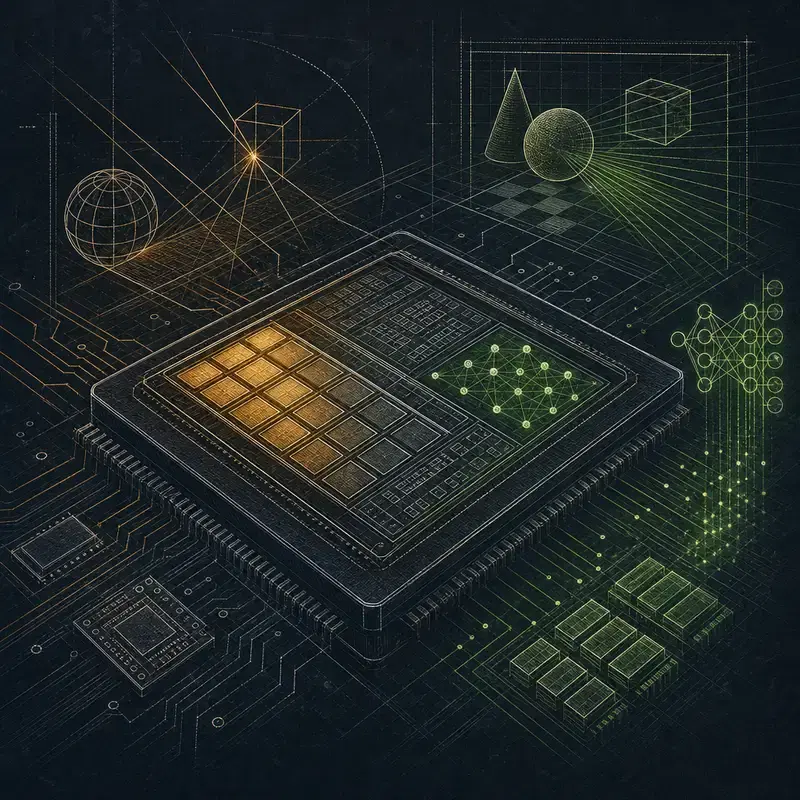
Notebookcheck's Mali G2-Ultra NX MP16 entry gives the floorplan clue that changes the conversation: it lists the GPU as a 16 core integrated graphics unit with Vulkan 1.4 support and 4 MB of L2 cache. More importantly, Notebookcheck says eight of the 16 compute units feature dedicated NX tensor cores for AI acceleration. That is not a decorative NPU parked somewhere else on the SoC, waving from across the interconnect like a tourist bus. For builders, that placement is the juicy bit. If half the compute units carry dedicated tensor hardware, Arm is signaling that neural workloads are not rare cinematic garnish. They are expected to show up often enough in graphics work that the GPU itself needs local helpers, like putting lock picks in the getaway crew's pockets instead of leaving them in a warehouse three neighborhoods over. Vulkan 1.4 support also matters because graphics features live or die by the developer path into the hardware. Notebookcheck reports the API support, while Arm Newsroom emphasizes the need for deep integration across both GPU architecture and the developer ecosystem. The practical takeaway is simple: hardware blocks become useful when engines can schedule them cleanly, not when a keynote slide gives them a dramatic glow.
Ray tracing gets
a mobile reality check Arm Newsroom specifically calls out a third-generation ray tracing unit in Mali G2-Ultra NX. That is worth pausing on, because ray tracing on mobile is the thermal betrayal waiting behind the velvet curtain. You can ask a phone to simulate beautiful light transport, but the battery, skin temperature, and memory subsystem will eventually start filing HR complaints. The smarter path is not ray tracing everywhere, all the time. It is ray tracing where it materially improves the scene, then leaning on neural reconstruction and image refinement to stretch the budget. Arm Newsroom frames the GPU as combining dedicated neural accelerators, a new execution engine, and ray tracing hardware, which reads less like three isolated features and more like a coordinated crew. KuCoin's news brief adds one performance datapoint, reporting Arm data showing up to a 14% performance improvement in non-AI gaming content. That number is useful precisely because it separates baseline rendering improvement from the neural graphics story. Builders should read it as a reminder to test both paths: conventional workloads still matter, but the architectural bet is clearly that AI assisted rendering will carry more of the visual load over time.
Scale is the quiet part of the teardown
Unite.AI describes Mali G2-Ultra NX as Arm's first AI-native mobile GPU, while Arm Newsroom says more than 14 billion Mali GPUs have shipped to date. That scale is not just trivia for a slide deck. It is the distribution mechanism that can turn a rendering technique from exotic demo into something mobile engine teams actually bother to support. There is also history here. Tom's Hardware previously reported Arm's Ethos-N57 and Ethos-N37 neural processing units as dedicated machine learning inference processors, alongside Arm GPU and display processor IP for different device segments. Mali G2-Ultra NX feels like the graphics side of that specialization story becoming more intimate: neural capability is moving from the general AI annex into the graphics building itself. For readers building games, engines, benchmarks, or even just choosing a future phone, the thing to watch is not one headline number. Watch how much work moves from classic shader throughput into neural reconstruction, frame generation, image refinement, and selective ray tracing. The mobile GPU is becoming less like a single muscle and more like a suspiciously competent heist crew, each block doing the job that wastes the fewest joules.