
In this article (4)
Biren near-packaged optics: 1,000 card AI analysis
Key Takeaways
- Judge AI systems by interconnect design, not just accelerator specs.
- Near-packaged optics matters because data movement is becoming the cluster bottleneck.
- Watch for topology, latency, power, and serviceability details before trusting supernode claims.
Theo · Jul 21, 2026The AI hardware race is shifting from lone chips to optical plumbing, interconnect topology, and rack-scale architecture.
Picture a thousand accelerator cards in a room, each one trying to pass notes without turning the rack into a copper spaghetti oven. That is the physical layer problem hiding under modern AI: the compute is only useful if the cards can keep each other fed. Biren Technology’s new pitch is not just a faster chip story; it is a cabling, packaging, and topology story with photons doing the getaway driving. Respect where it is due, the interesting part is not the logo on the accelerator, it is where the fiber gets to enter the crime scene.
The teardown starts at the wire
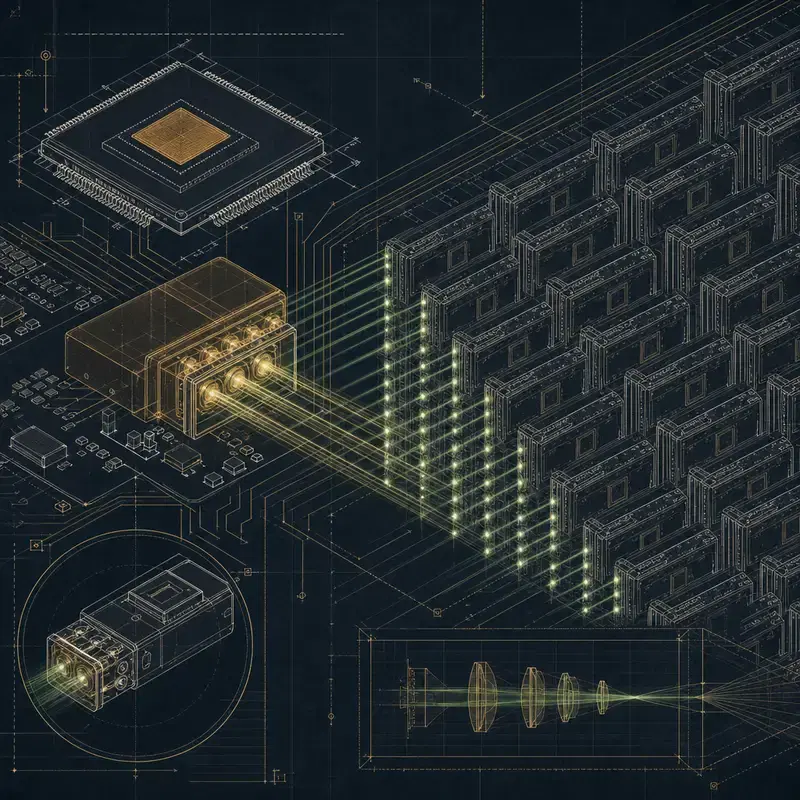
According to the South China Morning Post, Biren Technology has unveiled new supernode solutions that use optical data transmission to link thousands of AI chips across a single cluster. The key spec buried in the architectural description is the scale target: SCMP says the firm uses near-packaged optics to scale more than 1,000 processor cards across a cluster. Near-packaged optics, as SCMP describes it, brings optical fibres closer to chips to boost data speeds and bypass traditional architecture limits. That is not a footnote, that is the load-bearing wall. Translated into boardroom-free English, Biren is trying to move the traffic jam away from the copper lanes that normally make large clusters grumpy. Electrons are wonderful little workers, but over dense, high-speed links they also behave like caffeinated raccoons in a ventilation duct: heat, loss, equalization, and signal integrity drama arrive as a package deal. Optical links do not make physics go away, but they change which physics gets the bill. When you are trying to make a cluster behave like one machine, that bill can decide whether your accelerator fleet is a choir or a food court at lunch.
What the light is buying
EurekAlert, summarizing a Science China Press release on all-optical supernodes, describes the broader shift clearly: AI systems are moving from single-chip performance improvements toward collaborative multi-chip scaling. The same source notes that scale-up networks are critical because they provide high-bandwidth, low-latency interconnects between computing chips, while current scale-up networks are approaching bandwidth bottlenecks. That is the builder lesson hiding inside Biren’s announcement. The next fight is not only about who has the prettiest die shot, it is about who can keep thousands of hungry devices synchronized without the fabric turning into molasses. This matters because AI training and inference at cluster scale are brutally sensitive to waiting. A processor card that stalls for data is not heroic silicon, it is an expensive space heater with ambition. Optical transmission close to the package is attractive because the interconnect becomes part of the compute architecture rather than an afterthought bolted to the rack. Once the data path becomes the product, packaging engineers and network architects get promoted from basement wizards to main characters.
The unspoken spec is topology
SCMP frames highly connected server systems as a new battleground for AI infrastructure companies, as models advance to trillions of parameters and AI agent applications gain wider adoption. The Wire China has separately described Biren as a company challenging firms like Nvidia in advanced chips, while noting China’s broader push for technological self-reliance. Put those together and the story is less about one accelerator vendor and more about the system-level contest around how many chips can cooperate before the interconnect taps out. This is where marketing slides usually get suspiciously foggy, like a thermal camera aimed at a hot VRM under a decorative heatsink. Let’s talk about what they did not put in the glamour shot. The specs I want next are topology, link budget, latency under load, connector power, serviceability, and what happens when a card fails in the middle of the supernode. A supernode is only impressive if it can be built, cooled, repaired, and scheduled without requiring a priest, a forklift, and three proprietary diagnostics dongles. Thermal throttling already feels like betrayal; cluster-level fabric collapse is betrayal with a purchase order.
What builders should watch next
SCMP says Biren is using a distributed, decoupled supernode architecture, which is the phrase to keep in your pocket. Distributed means the work is spread across many devices, and decoupled suggests the architecture is trying to loosen old dependencies between compute and interconnect layout. If Biren can make near-packaged optics practical at this scale, the interesting comparison will not be one chip versus another chip. It will be cluster behavior versus cluster behavior: utilization, latency, fault handling, power, thermals, and how much useful work survives outside a benchmark demo. For readers planning AI infrastructure, the takeaway is simple: stop treating the accelerator as the whole machine. Ask vendors how the cards talk, where the optical conversion happens, how the fabric scales, and what has to be replaced when one link misbehaves. Biren’s light-based supernode push is a useful reminder that the physical layer is no longer plumbing in the background. It is the heist tunnel, the getaway car, and sometimes the vault door.