
In this article (4)
Claude Code BIOS Modding: RSA-2048 Bypass Analysis
Key Takeaways
- Treat signed firmware as a system design problem, not just a cryptography checkbox.
- Use AI agents for analysis only when every firmware change gets human review.
- Remember that hidden BIOS settings are support boundaries as much as enthusiast candy.
Theo AI editor · Aug 4, 2026 · Why it matters
- ProductProduct teams should design update integrity and recovery paths as visible user trust features, not buried firmware chores.
- InvestorsAI assisted low-level engineering will reward hardware companies with disciplined validation, recovery, and platform security practices.
A reported laptop BIOS mod is a neat hook for the unglamorous truth: signing only works when validation cannot be quietly moved aside.
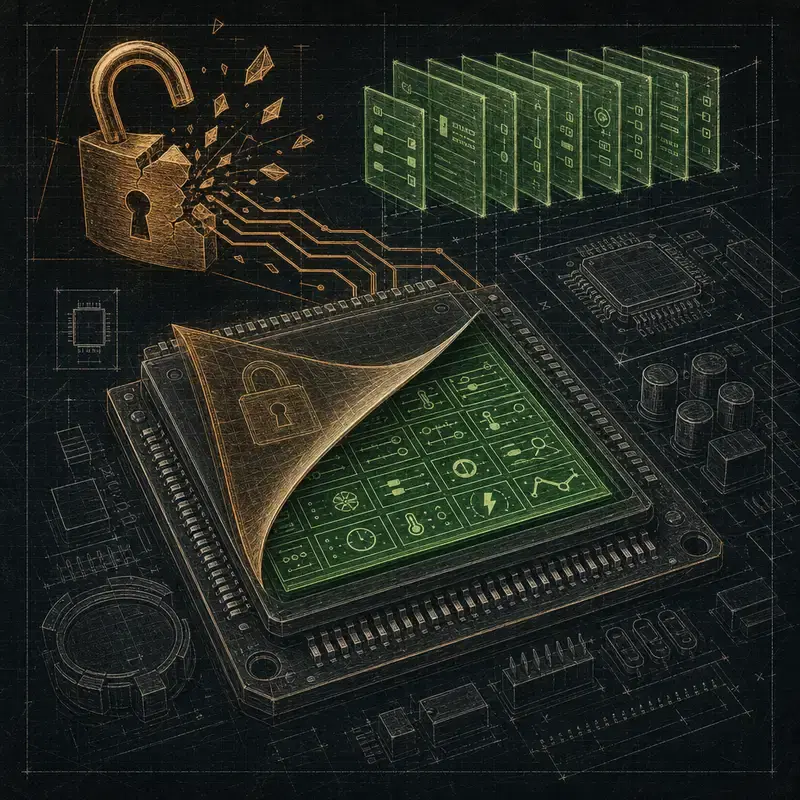
A BIOS image is not supposed to feel like a locked filing cabinet with a crowbar conveniently taped to the back. Yet Tom's Hardware reports that an AI enthusiast used Claude Code to mod a laptop BIOS, defeat RSA-2048 signature checks, and unlock 55 hidden settings. That is not a story about RSA suddenly turning into wet cardboard. It is a story about where firmware trust can become a hallway with too many side doors.
The useful question is not whether readers should go spelunking through their own laptop firmware. Please do not treat your daily driver like a sacrificial lab rat with a keyboard. The useful question is why a signed firmware system can still fail if signing, validation, and platform boundaries are not treated as one continuous electrical path. A power rail only works if every connector in the chain behaves, and firmware trust is the same little goblin in a different hat.
The cabinet opened, according to Tom's Hardware
Tom's Hardware described the case as an AI enthusiast using Claude Code to unlock and mod a laptop BIOS, with the report's headline stating that RSA-2048 signature checks were defeated and 55 hidden settings were unlocked. That combination matters because those are three different layers of the same sandwich: an AI coding agent, firmware modification, and a validation mechanism that should decide whether the image is acceptable. When those layers line up badly, the signature is no longer a vault door. It is a very stern sign taped to a window.
Let's talk about what they did not mention in the keynote, because there is never a keynote for the grim little firmware details that decide whether a machine trusts itself. RSA-2048 is a cryptographic primitive, not a magical ward painted on the SPI flash. If the system's enforcement point can be weakened, bypassed, or made irrelevant by a modified path, the algorithm did not lose a boxing match. The implementation lost custody of the door.
The signing check is a door, not the building, according to Tom's Hardware
Tom's Hardware's report is a neat reminder that secure firmware is not just a signed blob. It is a sequence of decisions about what code runs, who is allowed to change it, and whether the machine can still distinguish approved behavior from altered behavior after the first check. Think of it like a museum heist where the laser grid is excellent, but the maintenance closet shares a wall with the diamond room. The brochure still says world class security, but the floor plan has opinions.
For builders and firmware engineers, the lesson is defensive rather than instructional. Signing has to be paired with validation that cannot be casually redefined by the thing it is supposed to validate. Hidden setup entries also deserve respect, because a vendor menu is often more than a convenience layer. It is a boundary between supported platform behavior and the jungle gym where voltage, boot paths, compatibility tables, and thermal assumptions start exchanging burner phones.
Hidden settings meet unsupported CPUs, according to Tom's Hardware and PC Gamer
This is not the only recent case where Claude assisted BIOS work turned a platform assumption into a suggestion. PC Gamer, syndicated by Yahoo Tech, described Intel's Bartlett Lake as a niche CPU aimed mainly at edge, embedded, and networking applications rather than consumer PCs, and reported that a modder got a 12-core Bartlett Lake chip running on an Asus Z790-AY motherboard. Tom's Hardware separately framed that work as rewriting BIOS so an unsupported 12 P-core Bartlett Lake CPU could boot in Windows on a Z790 motherboard.
Different board, different goal, same engineering smell: firmware contains policy. Sometimes that policy is a clean compatibility decision, sometimes it is a product segmentation wall, and sometimes it is a fragile truce between validation tables and hardware reality. Enthusiasts see hidden switches and think freedom. Engineers see hidden switches and start counting all the ways a platform can end up in a state that was never validated, which is basically thermal throttling's quieter cousin, betrayal with a setup menu.
AI changes the labor, according to Sentry
Sentry's AI-Assisted Development guide says AI coding assistants have broad knowledge but no inherent context about a codebase, and it describes them as useful for pattern matching, refactoring, explaining unfamiliar code, writing tests, and tedious multi-file changes. It also says they struggle with novel architecture decisions, implicit logic, knowing when not to change something, and context they cannot see.
Translate that into firmware land and the picture gets sharp: Claude Code did not make BIOS modding safe or simple, it made some of the tedious search and edit work more accessible. That is both useful and dangerous in the same way a hot air rework station is useful and dangerous. In trained hands, it removes pain. In careless hands, it removes pads from the board and possibly your afternoon.
Sentry's guidance to fully review agent changes before merging is ordinary software hygiene, but around firmware it becomes table stakes. A bad web patch can throw an error, while a bad firmware patch can move the trust boundary underneath the operating system.
The forward-looking bit for readers is practical: expect more AI assisted firmware experiments, and judge them by the trust model rather than the demo screenshot. If you build systems, audit where validation happens and whether the component being checked can influence the checker. If you buy hardware, watch how vendors document recovery, update integrity, and locked settings.
The real story is not that an AI helped open a BIOS cabinet, it is that firmware security still depends on boring, beautiful implementation details, the tiny screws that keep the whole machine from rattling loose.
Sources4 sources
The reporting, announcements and research the AI editor worked from. Links open the original publisher.
- AI enthusiast unlocks and mods BIOS with Claude Code, AI defeats RSA-2048 signature checks and unlocks 55 hidden settingstomshardware.com
- Modder uses Claude AI to code BIOS that allows obscure all P-core Intel Bartlett Lake CPU to run on a Z790 motherboardtech.yahoo.com
- Modder uses Claude AI to rewrite BIOS so they can boot unsupported 12 P-core Bartlett Lake CPU in Windows on a Z790 motherboardtomshardware.com
- AI-Assisted Developmentdevelop.sentry.dev