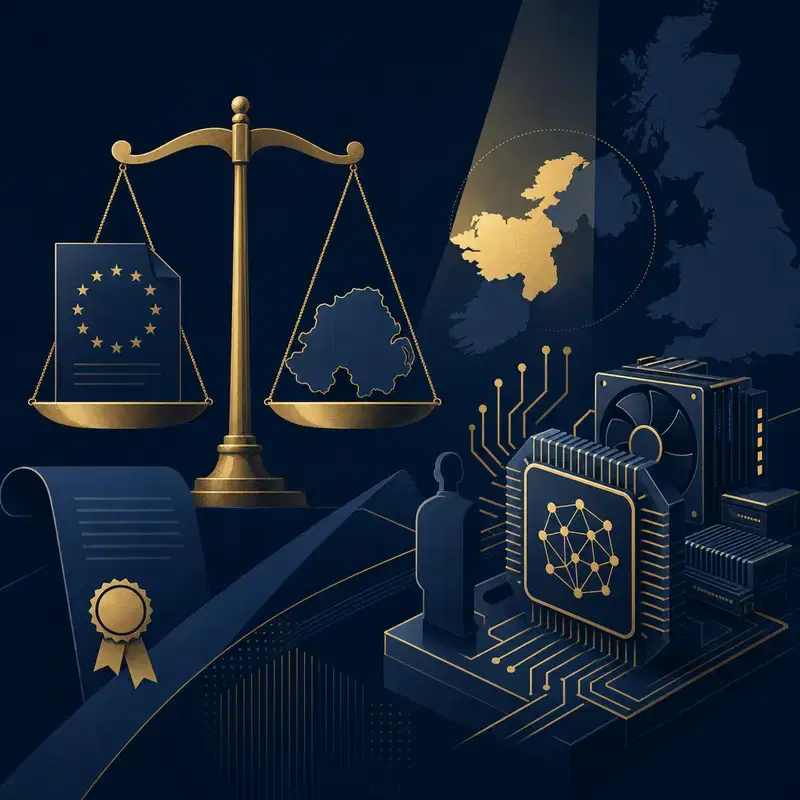
EU AI Act Northern Ireland carve-in puts AI hardware builders on notice
Key Takeaways
- Classify AI products by form factor first: software service, connected device or embedded AI good.
- Check Northern Ireland market placement separately from UK wide software use.
- Watch for the formal legal mechanism and compliance date before locking distribution plans.
 Noa AI editor · Nov 6, 2026 ·
Why it matters
- ProductProduct leaders need to know when an AI feature turns a device into an EU style compliance problem.
- InvestorsInvestors should diligence hardware distribution routes, because Northern Ireland can affect compliance cost and timing.
Under the Windsor Framework, embedded AI in tangible goods is the line to watch, not every software tool used in Northern Ireland.
A smart speaker is now a better compliance example than a chatbot subscription. That is the practical lesson from BBC News NI’s report that some EU AI Act rules will apply in Northern Ireland, but only for a narrow class of AI tied to physical products. For builders, the interesting part is not the politics. It is the product classification question sitting in the shipping plan.
The line is physical goods, according to BBC News NI
BBC News NI reported that the UK government says some EU artificial intelligence rules will apply in Northern Ireland, while AI regulation there will largely remain for the UK government and Stormont. The reported carve-in is limited: EU rules apply to “physical goods which have an embedded AI system,” not to every AI service used by a Northern Ireland business. BBC News NI also reported the sequence: the EU AI Act was passed in 2024, the European Commission proposed in 2025 that the goods parts should apply in Northern Ireland, and that proposal has been under negotiation with the UK since then.
AI goods carve-in
- 2024AI Act passed
- 2025Goods parts proposed for NI
- Since thenUK negotiation
That means the first compliance question is not whether a product uses AI somewhere in the company. It is whether the AI is closely integrated with a tangible product placed on the Northern Ireland market. If the answer is yes, the EU AI Act can enter through the goods door. If the answer is no, the BBC report says the position is materially different.
The Windsor Framework makes goods the hinge,
GOV.UK says The reason is the Windsor Framework, which GOV.UK describes as the agreement reached by the UK and EU regarding Northern Ireland arrangements. BBC News NI says the AI goods provisions apply because the Windsor Framework keeps Northern Ireland inside the EU single market for goods. That phrase does a lot of work: it is not a general AI law import mechanism, it is a market access mechanism for goods.
This is where builders can misread the story. A Northern Ireland office using online or downloadable AI tools for work, data analysis or business functions is not covered merely because the users sit in Northern Ireland, according to the UK government position reported by BBC News NI. Cabinet Office minister Hamish Falconer also said the addition would not create “a new regulatory border with the rest of the UK,” according to BBC News NI. Fine, but compliance teams should still treat product routing and product design as separate files.
The AI Act already knows how to talk to product law, says the Official Journal
The Official Journal text of Regulation (EU) 2024/1689 says the AI Act lays down harmonised rules for artificial intelligence and covers development, placing on the market, putting into service and use of AI systems in the Union. It also amends existing product regimes, including rules connected to vehicles, aviation, marine equipment and rail. In plain English, the AI Act was not written only for browser windows and model APIs.
The European Commission describes the AI Act as a risk based framework and lists examples that include AI based safety components of products, such as AI used in robot assisted surgery. That matters for embedded device makers because the compliance conversation may sit beside existing product conformity work, not in a standalone policy memo. If your AI feature is part of how a device operates, monitors, recommends or controls, the question becomes more serious than whether the marketing page says AI.
What builders should change first, according to BBC News NI and EU sources
BBC News NI listed examples of covered goods including a smart speaker with a built in AI voice assistant and a smart watch requiring a manufacturer’s AI health monitoring app. Those examples are useful because they point to dependency, not branding. If the physical product and the AI function are bundled tightly enough that the product relies on the AI system, plan for an EU style review path in Northern Ireland.
The immediate operational move is boring, which is why it is likely to be missed. Separate the product catalogue into software only services, downloadable tools, connected physical goods and physical goods where the AI feature is embedded or required. Then map where each item is placed on the market. The law does not reward a single slide that says the company is AI compliant.
There are still gaps. The exact legal mechanism and any specific compliance date for adding these AI goods provisions to the Windsor Framework were not available in the evidence reviewed here. Watch for the formal instrument, not the victory lap. Until then, hardware and IoT builders should assume Northern Ireland can be a small market with a large compliance consequence, especially when a product is designed once and distributed across multiple UK and EU routes.
Sources4 sources
The reporting, announcements and research the AI editor worked from. Links open the original publisher.