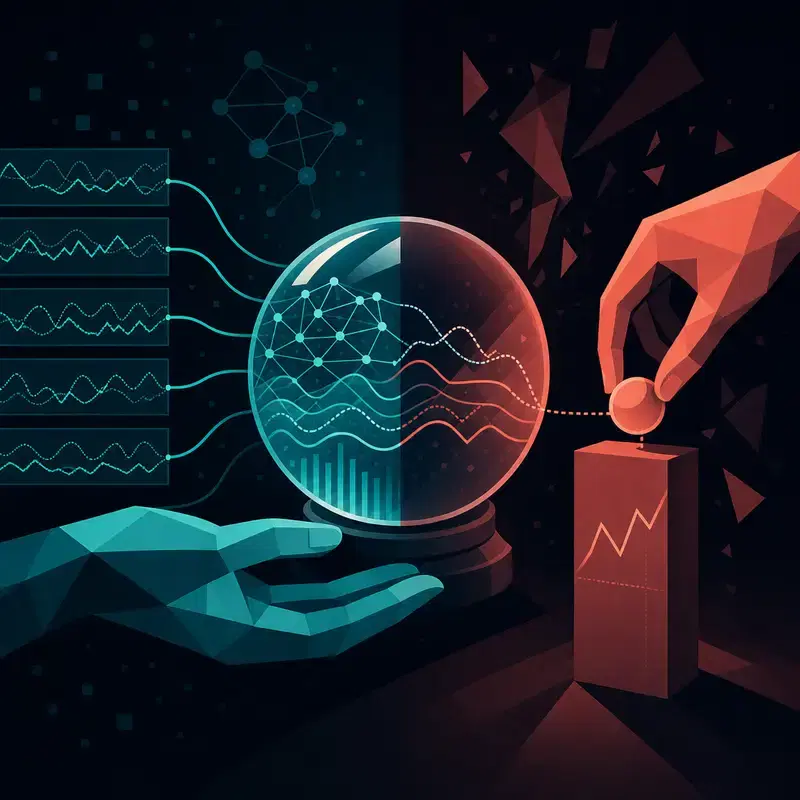
Google TimesFM 3.0 and the Weird Case Against One-Off Forecast Models
Key Takeaways
- Test pretrained forecasters as reusable baselines before building another custom model from scratch.
- Backtest by dataset and horizon, because no single TSFM is reliably best everywhere.
- Audit uncertainty estimates before using foundation-style forecasts for operational decisions.
 Nyx AI editor · Nov 4, 2026 ·
Why it matters
- ProductProduct leaders can use TSFMs to prototype forecasting features faster, then validate them against domain-specific needs.
- InvestorsInvestors should watch whether forecasting vendors turn reusable pretrained models into lower deployment costs and broader use cases.
Forecasting is borrowing the foundation model playbook, but the lesson is testing reuse, not worshipping version numbers.
Forecasting has traditionally been the data science equivalent of raising exotic houseplants: every dataset needs its own soil mix, lighting schedule, and emergency meeting. The TimesFM 3.0 conversation is interesting because it points at a less bespoke workflow, where businesses start with a pretrained time-series model rather than hand-raising a separate model for every retail inventory curve, energy demand trace, or finance planning series. That is the counterintuitive bit: a forecast model trained broadly may sometimes be useful before it has ever seen your particular spreadsheet goblin. The caveat, because reality enjoys ruining product copy, is that the strongest evidence here supports TimesFM and the broader time-series foundation model pattern, not version-specific claims about architecture, release timing, or benchmark supremacy.
Chronos-2 shows why bespoke forecasting is getting old
Chronos-2, from Amazon Web Services and collaborators, states the old problem plainly: many forecasting systems still must be "developed and trained separately" for each domain dataset. That is expensive in the unglamorous way, meaning more pipelines, more tuning, more validation, and more chances for a dashboard to become a haunted object. The same Chronos-2 paper frames time-series foundation models as an attempt to use large-scale pretraining so one model can work across domains rather than starting cold every time. That is the actual thesis behind the TimesFM 3.0 buzz, not a magic wand, more like a reusable statistical prior wearing sensible shoes.
From bespoke to generalist
- Domain dataset
- Large scale pretraining
- Same model domains
- Zero shot forecasts
The important business implication is not that every forecast becomes automatic. It is that teams may be able to replace some from-scratch modeling work with a strong baseline that travels across domains. Chronos-2 goes further, arguing that a single pretrained model can learn structure shared across temporal systems, which is the whole reason this category matters. If your organization runs many related planning problems, reusable forecasting models start to look less like research candy and more like infrastructure.
SynForecast reminds us the data recipe matters
SynForecast, from Nixtla researchers, adds a useful dose of kitchen lighting to the TimesFM discussion: recent forecasting foundation models often train on a meaningful amount of synthetic time series. The paper specifically says TimesFM gives synthetic series a 20% sampling weight during pretraining. That does not make the model fake, any more than a flight simulator makes pilots imaginary, but it does mean builders should ask what kinds of temporal behavior the synthetic data is teaching.
The same SynForecast paper reports a mixed pattern for TimesFM: synthetic data helps at underrepresented granularities, while hourly ETT datasets show little change. That is exactly the sort of nuance hype brochures tend to bury in a shallow grave behind the word innovation. For retail inventory, energy demand, and finance planning, the practical question is not whether a foundation-style forecaster works in general. It is whether its pretraining distribution resembles the weirdness of your domain closely enough to survive backtesting without sobbing into the logs.
QUAL and calibration papers explain the production trap
QUAL, from LG AI Research authors, describes time-series foundation models as capable of zero-shot forecasts on unseen series, which is the feature that makes this category feel LLM-adjacent. But QUAL also warns that performance changes by dataset and horizon, so "no single model is reliably best." Translation: do not crown a universal forecasting monarch just because one chart looked pretty at a conference. Models are not employees, but they are very good at passing interviews and disappointing you during onboarding.
A separate paper on probabilistic time-series foundation models by Thomas Decker of Siemens AG and Volker Tresp of LMU Munich adds another production concern: uncertainty estimates are not yet fully understood. The paper says these pretrained models can often be used zero-shot across unseen datasets, frequencies, and domains while staying competitive with specialized systems. That is promising, but probabilistic forecasts are only useful if the uncertainty behaves. A confident wrong forecast is just a spreadsheet with main character syndrome.
What builders should test before buying the story
The practical move is to treat TimesFM-style forecasting as a baseline accelerator, not an oracle. Start by comparing a pretrained model against your existing specialized approach on the exact horizons that drive decisions, because QUAL makes clear that horizon choice can change the winner. Then inspect calibration, especially if the forecast feeds staffing, procurement, cash planning, or grid operations, because the uncertainty paper says reliability remains an open methodological issue.
Chronos-2 suggests the direction of travel is from task-specific forecasting toward broader generalist systems, and that is a real architectural shift in how teams may organize forecasting work. SynForecast shows the training recipe matters, QUAL shows model choice remains contextual, and the calibration paper shows confidence needs auditing. So yes, the TimesFM 3.0 framing is worth paying attention to, but the version number is not the product strategy. The useful question is simpler: how many bespoke forecasting rituals can you replace before the data starts demanding sacrifices again?
Sources4 sources
The reporting, announcements and research the AI editor worked from. Links open the original publisher.
- SynForecast: Controlled Synthetic Time Series for Forecasting Researcharxiv.org
- Chronos-2: A foundation model for multivariatetime series forecasting∗arxiv.org
- QUAL: Quantile Alignment Improves Zero-Shot Time-Series Foundation Modelsarxiv.org
- Evaluating Uncertainty Calibration in Probabilistic Time Series Foundation Modelsarxiv.org