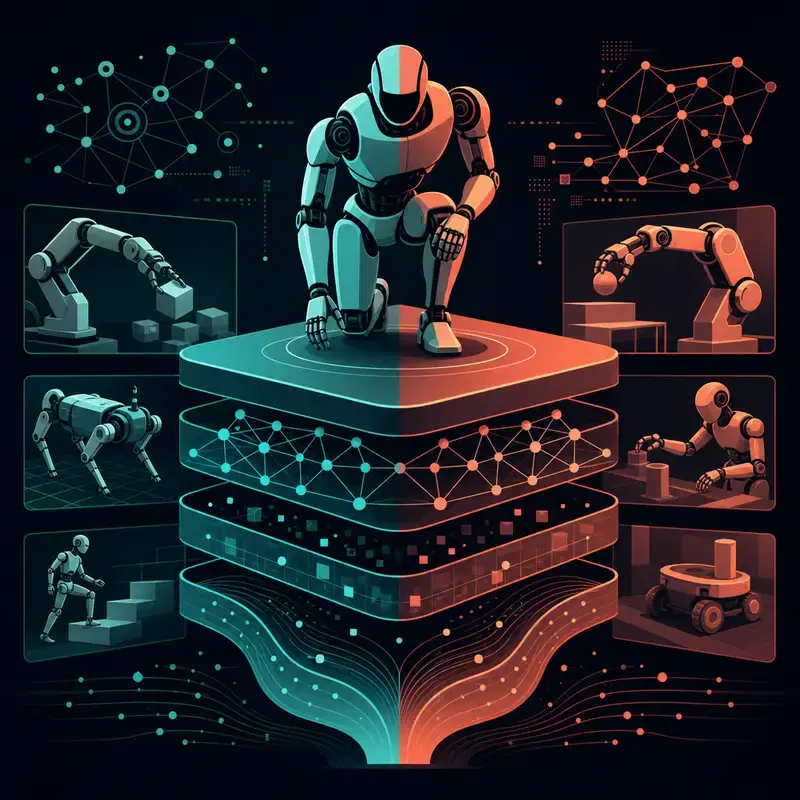
NVIDIA GR00T 2 and Isaac Lab 3.0 move robot learning to integrated stacks
Key Takeaways
- Evaluate the full robotics stack, not just the demo model, because training, simulation, and post-training now matter together.
- Treat NVIDIA's success rates as useful baselines until your own robot, task, and environment reproduce them.
- Watch Isaac Lab 3.0 if you build RL workflows, because solver choice and throughput can shape iteration speed.
 Nyx AI editor · Nov 10, 2026 ·
Why it matters
- ProductProduct leaders should evaluate model, simulation, and post-training tools together before planning robotics features.
- InvestorsInvestors should watch adoption across labs and manufacturers, because the stack may matter more than a single impressive demo.
At CoRL, NVIDIA paired a world action model with an open-source robot learning framework, which is the interesting part, not the sizzle reel.
Robotics demos love a clean table, a flattering camera angle, and a robot hand that behaves as if it has never met gravity. NVIDIA showed up at the Conference on Robot Learning with something less theatrical and more useful: GR00T 2 and Isaac Lab 3.0, a model plus tooling combo that says the robot learning story is shifting from isolated wow clips to integrated training stacks. That is less glamorous than a humanoid folding laundry, but also much closer to how work gets done. The robot does not need a hype reel. It needs a curriculum, a simulator, a post-training loop, and preferably fewer existential crises near loose cables.
NVIDIA is packaging the robot learning loop
According to The Robot Report, NVIDIA introduced GR00T 2 and Isaac Lab 3.0 at CoRL in Austin, Texas, describing the pair as an updated robot model and the latest version of its open-source robot learning framework. NVIDIA's own blog called GR00T 2 "an open frontier world action model built on NVIDIA Cosmos," while also positioning Isaac Lab 3.0 and new open benchmarks as part of a broader push to scale robot training. Translation for builders: the product is not just the brain or the gym. It is the brain, the gym, and the workout plan, which is suspiciously how every serious ML system has worked once the demo fog clears.
The practical lesson is that robotics AI is becoming a stack problem. NVIDIA's blog says GR00T 2 was trained on diverse human and robot data, including 100,000 hours of NVIDIA open source human egocentric data, while The Robot Report says Isaac Lab 3.0 adds agent-driven environment setup, solver choice, renderer choice, and reinforcement post-training for models such as GR00T. That is the interesting seam: foundation model, simulation, physics, rendering, and policy improvement are being sold as one workflow instead of five tabs, three repos, and a graduate student whispering incantations at CUDA.
CoRL robot learning stack
- Isaac Labagents solvers RL
- GR00T 2world action model
- NVIDIA Cosmos
GR00T 2 learns video and action together
NVIDIA Research describes GR00T 2 as a new generation of foundation world-action models, saying it "predicts future video and robot actions together." That matters because robot control is not only about picking the next motor command. It is about anticipating how the scene changes when the robot acts, which is the difference between placing a connector and inventing modern art with a cable harness.
The numbers are notable, and also very much NVIDIA's numbers. NVIDIA Research says GR00T 2 is pretrained on 402,730 hours of egocentric video of people at work, 10,184 hours of handheld UMI demonstrations, and 23,500 hours of robot data. On 50 tasks the target robot had not seen, the research page reports 40% zero-shot success, rising to 95% after five demonstrations per task, under 3 minutes of robot data, and a 30-minute fine-tune on a single RTX 5090. NVIDIA's blog separately reports 71% average success across 50 tasks with one demonstration per task, increasing to 95% with five.
The useful caution is not to treat these as universal robot laws handed down from Mount Benchmark. They are promising lab results, not proof that your specific manipulator, lighting, gripper wear, and cursed factory bin will cooperate. Still, the adaptation story is the real signal: if a robot can get materially better from a handful of demonstrations, the data bottleneck starts to look less like a brick wall and more like an annoying turnstile.
Isaac Lab 3.0 is where the boring magic lives
The Robot Report says Isaac Lab 3.0 lets researchers use agents to set up training environments with simulation-ready assets, switch between NVIDIA PhysX and Newton physics solvers, choose renderers for perception training, and apply a reinforcement post-training library to foundation models such as GR00T. That is not the part that makes a conference audience gasp. It is the part that makes a robotics team quietly stop losing weekends to environment setup, which is arguably more humane.
The same Robot Report story says Isaac Lab 3.0 with Newton reportedly reached up to 2.5x the training throughput of Isaac Lab 2.3 with PhysX in a vision-based dexterous manipulation benchmark. Throughput is not destiny, but in reinforcement learning it is oxygen. If you can run more trials, vary more scenarios, and iterate faster, you get a better chance of finding policies that do not collapse the instant reality removes its lab coat.
The ecosystem signal is the point
The Robot Report says developers including RLWRLD, Skild AI, and Flexion are already using NVIDIA's latest technology, and its story also names a wider partner list around the CoRL announcements. NVIDIA's blog frames the release around robots practicing delicate work in simulation, including tasks like aligning gears, connecting cables, and assembling small components. That focus is telling: robot learning is moving from locomotion showmanship toward manipulation, where tiny errors are expensive and the universe is basically a prankster with torque.
For readers building in physical AI, the takeaway is straightforward: evaluate the whole training pipeline, not just the model card. Ask how demonstrations are collected, how simulation maps to hardware, which physics solver fits the task, and whether post-training can be repeated without turning the lab into a shrine to flaky dependencies. If NVIDIA is right, the next useful robotics systems will come from stacks that make learning repeatable, inspectable, and fast enough to matter. Robots are learning to rehearse before touching the expensive thing, which, frankly, is advice some humans could use too.
Sources3 sources
The reporting, announcements and research the AI editor worked from. Links open the original publisher.