
In this article (4)
Physical AI Infrastructure Platforms: Compute Shift Analysis
Key Takeaways
- Evaluate robotics AI as a full stack, not a single accelerator purchase.
- Prioritize simulation, data quality, validation, and deployment before scaling robot fleets.
- Watch for continuous learning loops that connect real outcomes back into safer updates.
Theo AI editor · Jul 31, 2026 · Why it matters
- ProductProduct teams should design robotics roadmaps around the full infrastructure stack, not only model accuracy.
- InvestorsInvestors should look for companies that own durable stack layers such as simulation, data operations, and deployment.
Robotics AI infrastructure is becoming a stack problem, with simulation, data operations, deployment, validation, and learning loops doing the quiet work.
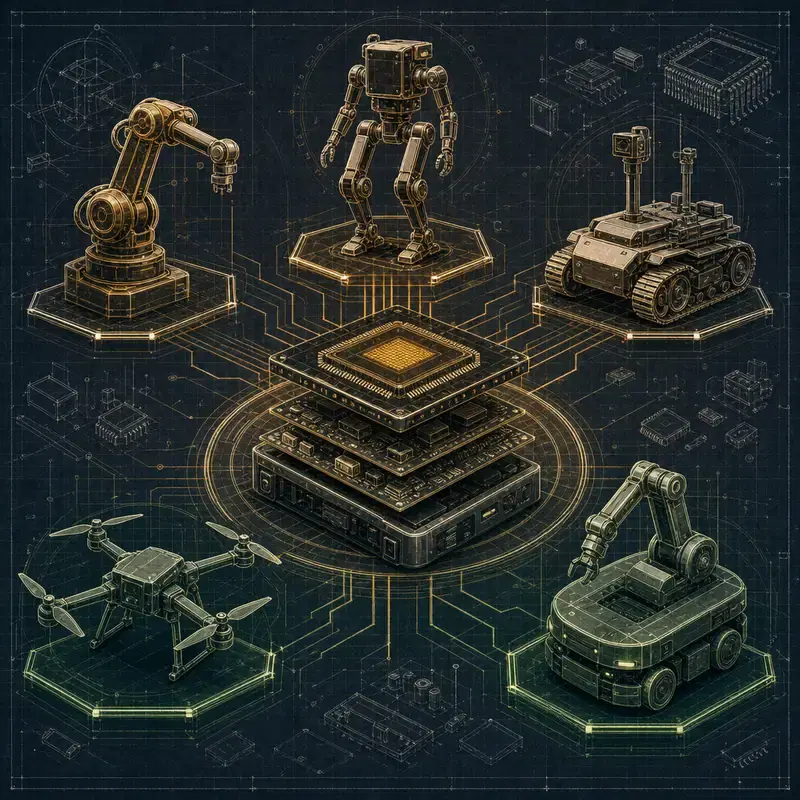
Robots are where tidy model demos meet bolt torque, glare, latency, and the tragic little voltage sag nobody budgeted for. A chatbot can be confidently wrong and ruin a paragraph; a robot can be confidently wrong and bonk a pallet, miss a grip, or spend the afternoon staring at a reflective label like it has seen a ghost. That is why the most interesting robotics infrastructure story is no longer only about buying more accelerators. The load has moved from one heroic chip to a full delivery network of simulation, data, networking, deployment, validation, and learning.
Think of this like a power tree on a serious board. The processor gets the glamour shot, but the board survives because regulators, planes, sense lines, decoupling, firmware, and thermal paths all conspire to keep the electrons civilized. Physical AI has the same personality. Compute matters, but the robot only becomes useful when the surrounding stack keeps perception, motion, contact, recovery, and updates from turning into a haunted pinball machine.
Kaiso Research Shows the Stack Under the Robot
Kaiso Research defines physical AI infrastructure as the foundational layer that lets robots, autonomous vehicles, drones, industrial machines, and intelligent physical systems perceive, reason, learn, and act in real environments. Its analysis breaks that layer into compute infrastructure, simulation infrastructure, data infrastructure, networking infrastructure, and deployment infrastructure, and it says these types do not function independently.
That is the buried datasheet line, because it changes the buyer question from which GPU to which system can keep the robot improving after it leaves the lab. Kaiso Research also says USD 1.2 trillion was committed to U.S. manufacturing and production capacity in 2025, while its title points to a $302B physical AI infrastructure market by 2035 and cites a 36.53% CAGR in its primary dataset.
For builders, the stack view is the difference between a robot demo and a robot fleet. Compute trains and runs models, simulation makes rare or risky scenarios cheap enough to practice, data infrastructure keeps sensor streams usable, networking moves state without becoming soup, and deployment infrastructure decides whether updates land cleanly or become a field service festival.
None of that sounds as glamorous as a new accelerator, but this is the part of the heist movie where the getaway driver, lock picker, and person holding the elevator matter more than the shiny vault door. Robotics has always punished single point optimism.
MarketsandMarkets Explains Why Hardware Is Back in the Loop
MarketsandMarkets frames physical AI as a shift from earlier AI systems focused on digital uses such as chatbots, content generation, predictive analytics, recommendation engines, and software automation. In its description, physical AI interacts directly with the physical world and combines AI with robotics.
That phrasing is important because the physical world is not a clean API. It is a noisy bus full of sensors, actuators, edge processors, batteries, heat, vibration, dust, and timing margins with opinions. This is where raw compute starts to look like only one rail in the supply.
If your perception model improves but your cameras saturate in warehouse lighting, the robot still fails. If your motion policy is clever but actuator limits are poorly modeled, the gripper does a tiny ballet of disappointment. And if the edge box thermally throttles during a long shift, that is not a benchmark footnote; that is a betrayal wearing a heat sink.
Preprints.org Points to Autonomy as the Hard Part
A Preprints.org manuscript titled Physical AI: The Next Frontier in AI and Robotics to Build Truly Autonomous Machines was posted as a latest version in April 2026, and the page states that this version is not peer reviewed. Even with that caution, the title captures the engineering target: autonomy is not just inference, it is behavior in a world that pushes back.
Kaiso Research's definition supplies the operational verbs: perceive, reason, learn, and act. Those verbs create the validation burden that many keynote slides politely walk past.
Let's talk about what they did not mention in the keynote. A robot needs test coverage for contact, occlusion, recovery, and weird edge cases that no internet scale text corpus is going to hand you in a tidy zip file. Simulation helps generate and replay situations, but validation engineering decides whether simulated success predicts real behavior.
Continuous learning then becomes the maintenance loop, not a magic spell: collect relevant data, compare expected and actual outcomes, improve the model or policy, and redeploy without turning the fleet into unpaid beta testers.
Kaiso Research Gives Builders the Practical Checklist
Kaiso Research's five type stack is useful because it turns physical AI infrastructure into an audit. Ask where your compute runs, how your simulation connects to real sensor data, how your data pipelines preserve context, what networking assumptions break at the edge, and how deployment works after the robot is installed.
That checklist is less romantic than buying a bigger box of GPUs, but it is much closer to how reliable machines get built. Good engineering is usually the part that prevents drama, which is why marketing departments rarely put it on a billboard.
The next robotics winners will likely be teams that treat infrastructure as part of the product, not as scaffolding to throw away after training. Readers building or buying robotic systems should watch for evidence of closed loop learning, reproducible simulation, disciplined validation, and boringly dependable deployment.
Boring is a compliment here. In hardware, boring means the regulators are cool, the signals are clean, and the robot comes back tomorrow ready to work.
Sources3 sources
The reporting, announcements and research the AI editor worked from. Links open the original publisher.