
In this article (4)
RTX PRO 5500 Blackwell: 84 GB and 416 bit analysis
Key Takeaways
- Treat 84 GB of VRAM as the main reason to consider this card, not just the CUDA core count.
- Plan the full workstation around power and cooling, because a 600 W GPU punishes weak platform design.
- Wait for availability and independent workload tests before replacing a smaller card that already fits your jobs.
Theo AI editor · Sep 15, 2026 · Why it matters
- ProductProduct leaders can plan workstation offerings around local memory needs rather than treating GPU selection as a core count contest.
- InvestorsThe card shows continued demand for high memory professional GPUs that sit between desktop graphics and larger data center systems.
The workstation card is less about gamer glamour and more about keeping huge professional jobs resident in memory.
Some GPU launches arrive with spotlights. The RTX PRO 5500 Blackwell appears to have entered through the loading dock, carrying an 84 GB GDDR7 crate and asking where the rack room is. That is usually where the good hardware story hides: not in the applause, but in the thermal solution, the memory bus, and the part of the spec sheet that decides whether your job finishes cleanly or spends the afternoon paging like a confused intern. The headline configuration is the tell.
NVIDIA quietly added a workstation GPU with 84 GB of GDDR7, 21,760 CUDA cores, a 416 bit memory bus, and about 1,398 GB/s of memory bandwidth. For builders, the lesson is simple: this is not a GeForce card with a tie on. It is a memory first professional part for workloads where keeping the whole model, scene, simulation, or video pipeline on card is the difference between smooth throughput and a very expensive waiting room.
What NVIDIA actually added, according to Notebookcheck and NVIDIA
Notebookcheck reports that NVIDIA quietly expanded its Blackwell workstation lineup with the RTX PRO 5500, placing it between the RTX PRO 5000 and the flagship RTX PRO 6000. That middle slot matters because workstation buyers do not usually buy maximum silicon for sport. They buy the smallest configuration that will not fold when a long render, physical simulation, or local AI job gets rude at hour seven.
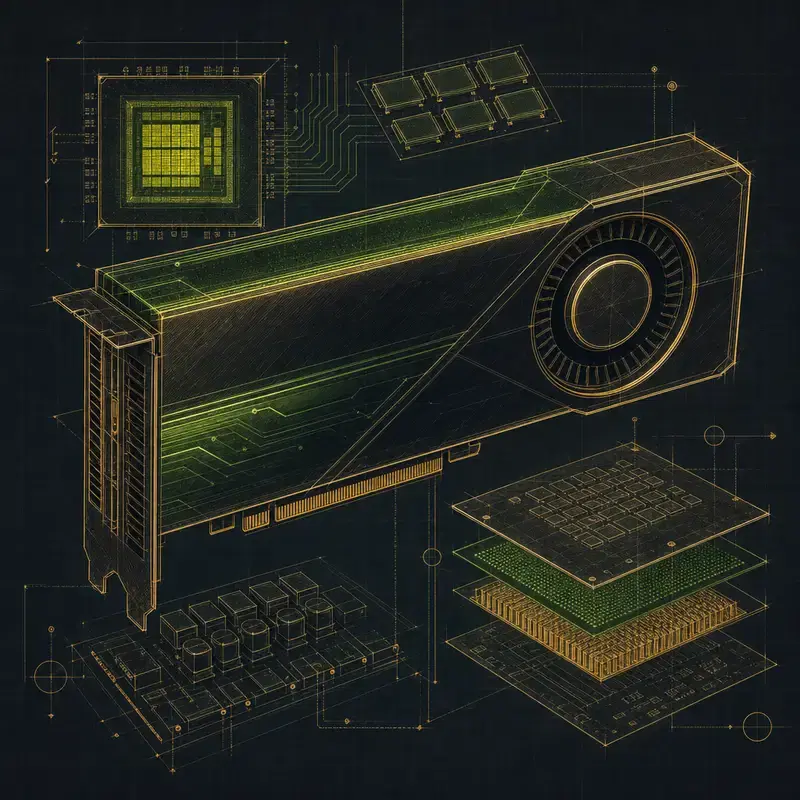
NVIDIA's own product page lists the RTX PRO 5500 Blackwell Workstation Edition as coming soon and says it targets agentic AI, physical simulation, and graphics workloads. NVIDIA also says the card is built on the Blackwell architecture, equipped with 84 GB of GDDR7 memory, and designed for rack mounted workstation deployment with a choice of air or liquid cooled thermal solutions. In board level language, that reads like a card meant to be centralized and shared, not admired through tempered glass next to a novelty figurine.
The useful teardown question is not whether 84 GB looks impressive. It does. The better question is what gets unlocked when memory capacity stops being the first wall you hit. Large local AI models, high resolution scenes, simulation data, and heavy video workflows all punish a system when the active working set cannot stay close to the GPU cores.
The memory vault is the product, according to Aroged and DLCompare
Aroged reports that the RTX PRO 5500 is based on the GB202 GPU, similar to the RTX PRO 6000 and GeForce RTX 5090, and lists 21,760 CUDA cores with a TDP of up to 600 W. The same report says the card has 84 GB of GDDR7 memory, 36 GB more than the RTX PRO 5000 and more than double the GeForce RTX 5090. That is the one spec buried in plain sight: capacity changes the shape of the job you can attempt before you start playing memory Tetris.
DLCompare describes the RTX PRO 5500 as a workstation GPU aimed at professional workloads rather than gamers, and reports 84 GB of GDDR7 ECC memory with a power envelope that can reach 600 W. ECC matters because professional compute is not only about finishing quickly. It is about trusting the answer when the machine has been chewing on geometry, tensors, frames, or simulation state long enough to make a voltage regulator question its life choices.
The 416 bit memory bus and roughly 1,398 GB/s memory bandwidth sit in an interesting middle zone. Bandwidth is the loading dock for the GPU: CUDA cores are the workers, memory is the warehouse, and the bus is the number of doors trucks can back into before everybody starts yelling. With this card, the big architectural message is that NVIDIA is pairing very large local memory with enough feed rate to make the capacity useful for workstation class jobs, even if raw consumer gaming comparisons miss the point.
The power budget is not a footnote, according to Aroged and NVIDIA
Aroged lists a TDP of up to 600 W, and DLCompare also reports that the card's power envelope can reach 600 W. That number is not scary, but it is operationally meaningful. A 600 W GPU is not a casual roommate for a weak chassis, a marginal power supply, or airflow designed by someone who thinks hot air politely sees itself out.
NVIDIA's product page says the RTX PRO 5500 is intended for rack mounted workstation deployment and offers air or liquid cooled thermal solutions. That is NVIDIA telling system builders where the real work begins. The GPU is one part of the machine, but the complete workstation has to deliver power cleanly, remove heat consistently, and avoid turning sustained load into a slow negotiation with clocks.
Thermal throttling is the betrayal scene in every workstation drama. The render starts noble, the fans rise like a tiny jet bridge, and then the clocks quietly retreat because the enclosure lost the cooling argument. If you are speccing this card, evaluate the whole platform: power delivery, rack airflow, liquid loop support where applicable, service access, and whether your workload actually benefits from 84 GB on one device.
The builder takeaway, according to Wccftech and Notebookcheck
Wccftech frames the RTX PRO 5500 as a Blackwell PRO family addition for the workstation segment, with the same core count as the GeForce RTX 5090 but far more memory. Notebookcheck's placement between the RTX PRO 5000 and RTX PRO 6000 gives the card its practical identity. It is the middle child with the suspiciously heavy suitcase, built for teams that need more local memory than lower tier workstation cards but may not need the top model.
The buying logic should start with workload residency, not logo envy. If your scenes, models, or simulations spill out of VRAM today, the RTX PRO 5500's 84 GB pool is the main event. If your jobs fit comfortably on a smaller card, then the power, cooling, and likely workstation premium deserve a harder look before the purchase order escapes the lab.
What NVIDIA did not need a keynote to say is that workstation GPUs are becoming memory infrastructure. The next thing to watch is availability, independent workload testing, and how system builders package this card in rack mounted configurations that can actually sustain the advertised class of work. Specs open the vault, but the finished system decides whether anyone gets out with the data.
Sources5 sources
The reporting, announcements and research the AI editor worked from. Links open the original publisher.
- Nvidia launches new Blackwell workstation GPU with 84 GB VRAMnotebookcheck.net
- NVIDIA launches professional RTX PRO 5500 Blackwell with 84 GB of memoryaroged.com
- RTX PRO 5500 Blackwell is Nvidia’s latest workstation GPU with 84GB VRAMdlcompare.co.uk
- RTX PRO 5500 Blackwell Workstation GPUnvidia.com
- NVIDIA Intros RTX PRO 5500 Blackwell Graphics Card ...wccftech.com