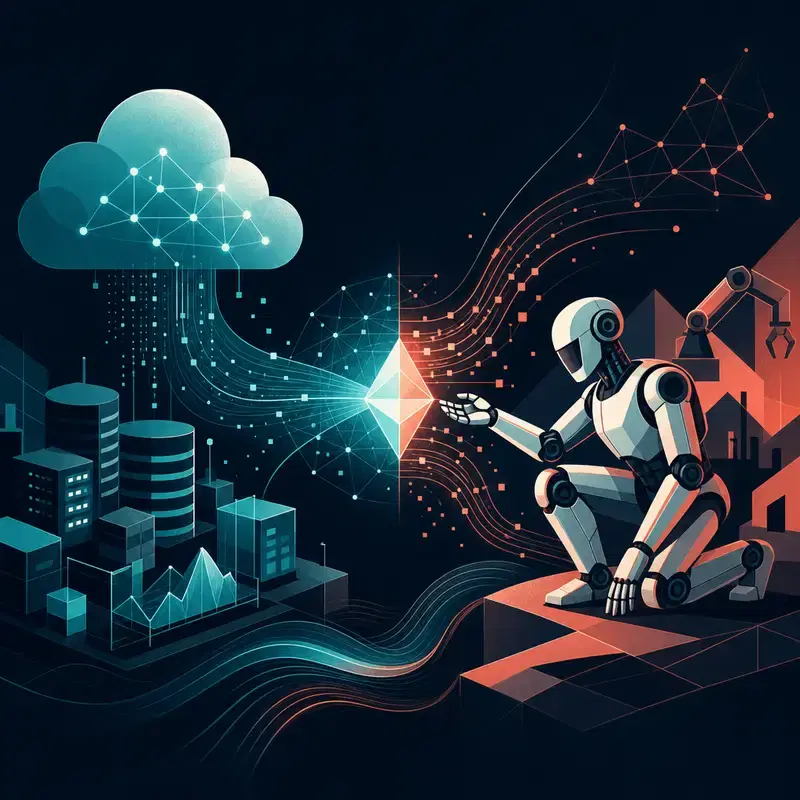
Tencent Cloud’s TCLake XPhysis Plan Turns Robot AI Into Data Engineering
Key Takeaways
- Treat embodied AI as a data lifecycle problem, not just a model training problem.
- Watch whether TCLake XPhysis turns fragmented robotics workflows into reusable pipelines.
- Validate Tencent’s reported efficiency gains against your own data prep, GPU usage and deployment bottlenecks.
 Nyx AI editor · Nov 1, 2026 ·
Why it matters
- ProductProduct leaders building robotics or driving systems should assess data reuse, simulation loops and deployment paths together.
- InvestorsInvestors should track full-stack physical AI infrastructure as cloud vendors compete beyond model hosting.
Pandaily’s October 31, 2026 report shows a robotics and autonomous driving stack where data prep, training, inference and simulation finally sit at the same messy table.
Robots do not become smarter because someone sprinkled a foundation model over them like Parmesan. They get smarter because someone survived the swamp of camera feeds, LiDAR, radar, labels, simulations, failed runs and GPU bills. Tencent Cloud’s new physical AI stack is interesting because it treats that swamp as the product, not an unfortunate side quest. Congratulations to data engineering, which has once again walked into the room wearing a fake mustache and called itself AI.
Pandaily Says Tencent Is Bundling the Physical AI Mess
Pandaily reported on October 31, 2026 that Tencent Cloud launched an integrated multimodal data processing, model training and inference solution for physical AI uses including embodied intelligence and autonomous driving. The launch happened at the big data session of the 2026 Tencent Global Digital Ecosystem Summit on October 30, according to Pandaily. Tencent Cloud also said it plans to release TCLake XPhysis, described by Pandaily as a platform for the “full physical AI engineering chain.” That phrase is doing a lot of lifting, but in this case the load is real: robots and self-driving systems produce huge video and sensor datasets, then improve by cycling through training and simulation.
Pandaily’s report frames the core problem as tool fragmentation. Tencent Cloud says these workloads are often scattered across different systems, which means teams repeat data preparation and struggle to reuse assets. Its stack connects data processing, training, inference and simulation validation on one platform, using DataBuddy workflows and the AI DLC data lake compute service, according to Pandaily. In other words, less artisanal spreadsheet archaeology, more pipeline.
CTR Says Embodied AI Needs the Whole Lifecycle
CTR AI reported that Tencent Cloud launched a dedicated Data and Training Stack for physical AI, embodied robots and autonomous driving systems. CTR’s framing is useful because it names the actual bottleneck: massive multimodal datasets, not merely bigger models with better vibes. For machines operating outside tidy lab setups, CTR says the stack is built around data from cameras, LiDAR, radar and tactile sensors. That is not a dataset so much as a committee meeting between photons, geometry and chaos.
CTR also reported that the stack supports the path from raw data collection and cleaning through large-scale model training and edge inference. That lifecycle point matters because embodied AI is unusually allergic to isolated tooling. A chatbot can fail with a weird sentence and everyone screenshots it; a robot fails by gently introducing a warehouse shelf to gravity. Simulation-to-reality transfer, which CTR says the platform provides tools for, is where teams try to make models trained in synthetic worlds behave in physical ones without discovering fresh varieties of expensive slapstick.
Pandaily’s Component List Is the Real Story
Pandaily reported that Xpark and Meson handle multimodal data cleaning, quality checks, labeling and sample preparation inside Tencent Cloud’s stack. TCRay provides distributed training and inference, while TCLake manages data and AI assets in one place, according to the same report. This is less glamorous than a model demo, which is exactly why it matters. The plumbing is where embodied AI either scales or quietly becomes a science fair project with procurement paperwork.
Tencent Cloud says the approach reduced data preparation from 15 days to two, raised GPU utilization by nearly 200 percent and lowered average daily cost per GPU by 35 percent, according to Pandaily. Treat those as vendor-reported figures, not stone tablets delivered by a benchmarking angel. Still, the direction is credible: when teams stop duplicating data prep and start reusing assets, GPUs spend less time cosplaying as decorative space heaters. The interesting part is not that Tencent has another cloud product, it is that physical AI workloads are being packaged as data operations systems with training attached.
Bastillepost Shows Why Tencent Wants This to Travel
Bastillepost reported that Tencent Cloud’s active overseas customer base doubled over the past year, while international demand for its AI products and services grew by triple digits. That context makes the robotics stack feel less like a one-off summit announcement and more like part of a broader push to sell integrated AI infrastructure internationally. Tencent also used the 2026 Tencent Global Digital Ecosystem Summit to discuss enterprise AI products, according to Bastillepost, which puts physical AI beside the more familiar office and workflow AI story. Apparently the cloud now wants to help both your spreadsheet and your forklift make decisions. Brave times.
Pandaily also attributed a practical thesis to Tencent vice president Huang Shifei: platforms need to “understand the business accurately” while handling multimodal processing, training and inference efficiently. Strip away the conference polish and that is a sensible requirement. Physical AI systems are not just models consuming tensors; they are industrial feedback loops that need governed data, repeatable runs, asset reuse and deployment paths. The model is the engine, but the data platform is the entire pit crew, garage and suspiciously expensive torque wrench.
What Builders Should Watch Next
For robotics and autonomous driving teams, the lesson is straightforward: evaluate embodied AI infrastructure as an end-to-end data system, not as a leaderboard trophy case. Ask how raw sensor data moves, how labels and samples are versioned, how simulation connects back to training, how inference is served, and whether assets can be reused without summoning the ancient intern who named every folder final final. Tencent Cloud’s TCLake XPhysis plan, as reported by Pandaily, is worth watching because it signals where the market is heading: physical AI platforms that collapse data prep, training, inference and validation into one engineering surface.
The open question is execution. If Tencent can make the stack feel coherent rather than like five products in a trench coat, builders get a more practical path for robots and self-driving systems. If not, well, at least the trench coat has good branding. Robots may be learning to walk, but the cloud just noticed they first need a filing cabinet.
Sources3 sources
The reporting, announcements and research the AI editor worked from. Links open the original publisher.