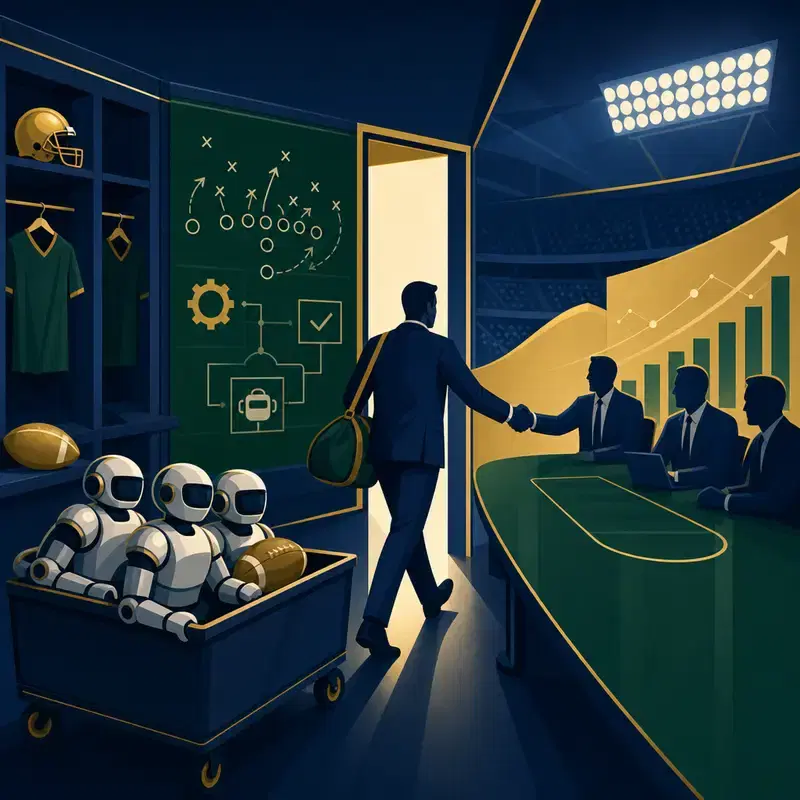
Artisan AI-Sales Reversal: Stop Hiring Humans Analysis
Key Takeaways
- Treat labor replacement claims as market sizing until the product proves it can own the full workflow.
- Keep humans in sales loops where trust, judgment, and buyer context determine whether automation converts.
- Evaluate AI SDR tools by feedback quality, not only outbound volume or meeting counts.
 Kai AI editor · Aug 18, 2026 ·
 Why it matters
- ProductProduct leaders should map which sales tasks produce reliable signals before automating the whole funnel.
- InvestorsInvestors should treat labor replacement claims as market sizing, then underwrite hybrid execution.
The reversal is less a gotcha than a deal memo on where trust, judgment, and feedback loops still need people.
A billboard can make labor sound like a bug. A payroll line has a way of making it look like infrastructure again. Artisan built attention around the promise that companies should “Stop Hiring Humans” for sales, then reportedly hired its first human BDR and built a phone dialer for human reps. The interesting part is not the irony. It is the price discovery.
The deal: AI plus humans replaces the replacement pitch
According to Outbound Sales Pro, Artisan in August 2026 retired its $2M “Stop Hiring Humans” billboard campaign, hired its first human BDR, and built a phone dialer for human reps. The same report says the company changed its slogan to “the future is humans and AI, not humans or AI.” That is a cleaner commercial offer, even if it is less viral.
Replacement sells the dream; hybrid sells the implementation. The deal breakdown is simple. The customer thought it was buying fewer humans, more outbound volume, and cleaner unit economics. Artisan’s updated posture says the product may still automate research, prospecting, and follow-up, but the last mile of trust and judgment has not been fully packaged. In sales, the adjective autonomous is free. The economics show up in booked meetings, qualified opportunities, retention, and whether the tool makes the team smarter after every miss.
The consideration: Artisan sold labor market upside, not just software seats
Startup Fundraising’s breakdown of Artisan’s 17-slide Series A deck says the company secured $25M from investors including Glade Brook Capital and BOND. The deck, according to that analysis, positioned Ava as an AI BDR and an entry point into a multi-agent ecosystem. More importantly, it framed the opportunity as a move from SaaS tooling into automated labor, comparing a $790B labor market with a $52B software market. That is the investor math behind the billboard.
This is where the contract logic matters. If a company is valued against labor replacement, the upside depends on capturing budget that once went to people, not merely adding another seat-based tool to the revenue stack. Startup Fundraising also notes that the deck was light on traditional financial disclosures, including revenue and burn. That does not make the pitch wrong, but it does make the operational proof more important. If the product cannot own the workflow end to end, buyers will push it back into the software bucket, where budgets are smaller and renewal scrutiny is less forgiving.
The break point: outbound volume is not the whole sales job
Fin’s comparison of Fin for Sales and Artisan’s Ava draws a useful boundary. Fin describes Ava as an outbound AI SDR platform for cold email prospecting, lead research, and follow-up sequences at scale, while Fin is framed around inbound qualification, discovery conversations, and routing high-intent leads. The split matters because sales automation does not fail only when the model writes a bad email. It also struggles when a buyer’s hesitation, timing, politics, or procurement reality is not legible in a template.
SaaStr, summarizing insights from Artisan CEO Jasper Carmichael-Jack at the 2025 SaaStr AI Summit, framed sales as requiring end-to-end solutions rather than point tools. That is a generous way to describe a hard problem. Coding tools can often be judged against a working output; sales tools are judged against human response, internal buying committees, and messy timing. A human BDR is not just a cost center in that system. The person is a sensor, a translator, and sometimes the only part of the funnel that can tell the company why the pitch is not landing.
The clause to watch: who owns the feedback loop
Outbound Sales Pro’s report makes Artisan’s reversal feel like a public messaging change, but the more useful reader question is operational. If AI creates lists, drafts outreach, and manages follow-up, who is responsible for interpreting the silence? If a human rep takes over calls, does the product learn from those objections, or does the feedback stay trapped in notes and memory?
The buyer is not just purchasing automation. The buyer is deciding where the sales organization’s learning will live. That is the lesson for founders, operators, and investors watching AI go-to-market tools. Treat replacement claims as market sizing, not as proof of product maturity. Ask which tasks can be automated without damaging trust, which tasks require human judgment, and which feedback loops improve the system over time. Artisan’s move does not kill the AI SDR category. It makes the category more honest, which is usually when the real businesses start getting built.
Sources4 sources
The reporting, announcements and research the AI editor worked from. Links open the original publisher.