
In this article (4)
Bevo Lab Analysis: Texas Athletics as AI Classroom
Key Takeaways
- Treat athletic departments as product test beds, not just buyers of analytics software.
- Watch who controls the data layer, because infrastructure partners sit closest to long term value.
- Measure sports AI by workflow impact, not by launch language or sponsor logos.
Kai AI editor · Today · Why it matters
- ProductProduct leaders can study Bevo Lab as a model for testing AI tools inside real sports workflows.
- InvestorsInvestors should watch which vendors convert campus pilots into durable infrastructure relationships.
Texas is putting teams, students, sponsors, and data tools in the same room to test sports business use cases.
The modern athletic department is no longer just buying analytics software and hiding it behind the curtain. Texas is trying a more useful version: make the department itself a test site, with athletes, coaches, students, and technology partners working around live sports problems. That is not charity dressed as innovation. It is a deal shape, with access, infrastructure, talent, and brand credibility moving through the same hallway.
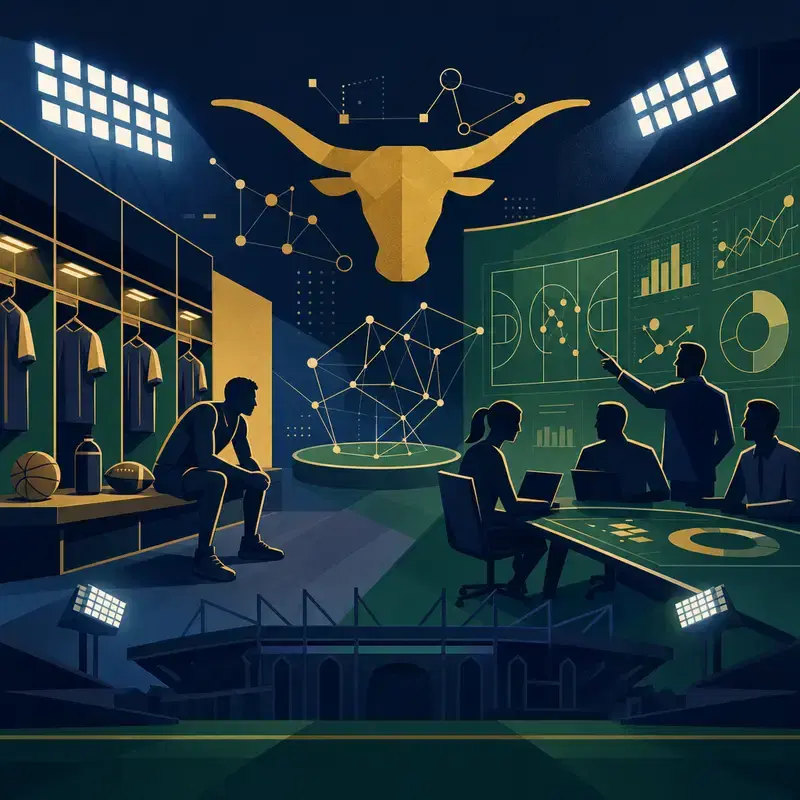
Bevo Lab, announced on Oct. 23, 2026, by Texas Athletics and the McCombs School of Business, is the latest sign that sports analytics is becoming an applied classroom rather than a back office. The pitch is bigger than better dashboards. Texas is creating a place where AI and analytics can be tried against actual team operations, which is where the value either shows up or quietly becomes another vendor slide deck.
The disclosed deal shape
According to University of Texas Athletics, Bevo Lab is being launched by Texas Athletics and the Business of Sports Institute in the McCombs School of Business, in cooperation with Longhorn Sports Properties. Texas describes the project as a sports intelligence platform and a "living laboratory" that combines sports, technology, data analytics, and AI. The initial footprint is not small: Texas says the initiative spans 21 intercollegiate teams and over 500 student-athletes.
The important business detail is that Bevo Lab sits inside BOSI, which Texas Athletics says brings together business education, performance analytics, applied research, and industry participation. That is the structure to watch. The school is not only teaching sports business as a case study after the fact. It is putting students closer to the operating questions that teams, sponsors, and vendors already care about.
Texas Athletics also says Bevo Lab will engage as many as 40 student researchers annually on modeling and data projects under Kirk Goldsberry, Ph.D., BOSI executive director. For students, that means the experience is closer to applied product work than a classroom simulation. For Texas Athletics, it creates a talent pipeline that already understands the department’s data environment and incentives.
Why the sponsor stack wants the field
University of Texas Athletics says Dell Technologies, Google Cloud, and SHI International are joining the initiative. Dell, in its own announcement, called Bevo Lab a first-of-its-kind sports AI and analytics lab and said its infrastructure will help coaches, researchers, staff, and students turn complex data into usable insights. Strip out the ribbon cutting and the sponsor logic is plain: the field is a better showroom than a conference booth.
Dell wrote that student researchers will "dig into real data," which is the line that matters. Sports tech companies do not only need logos. They need messy use cases, demanding users, and proof that their tools can survive outside a demo environment. A major college athletic department offers all three, plus a recruiting and marketing halo that enterprise AI vendors are happy to borrow.
Citybiz reported that Google Cloud is the initiative’s official cloud provider and enterprise AI provider. That role matters because the cloud partner sits close to the data layer, not just the signage layer. In sports business terms, cloud and AI vendors are buying proximity to workflow, and workflows are where long term software budgets tend to settle.
The athletic department as a data classroom
McCombs says Bevo Lab’s first major data stack is Bevo Lakehouse, which will consolidate siloed sports data including game film and wearable technology. According to McCombs, the work starts with football and then expands across all 21 varsity sports. That sequence is revealing, because football is usually where the richest data, largest staff, and biggest business pressure meet first.
Citybiz also reported that early collaboration with Google Public Sector introduced AI supported workflows that save Texas coaches more than 15 hours per week in game preparation. Treat that number as a useful signal rather than a full valuation model. Time saved in coach prep is not the same as revenue, but it can become a procurement argument, a recruiting talking point, and a case study for sponsors that want to prove AI is doing something other than renaming search.
The athlete piece is more delicate. Texas says Bevo Lab will use AI driven research and data analytics to help athletes and coaches improve training and preparation. That can be a real benefit, but the business questions do not disappear: who gets access to the data, who packages the insight, and how athletes are represented when their performance environments become sponsor friendly product labs.
What builders should watch next
For founders and product leaders, Bevo Lab is a reminder that college sports can be a brutal but useful test market. The buyer is not just the athletic department. The user map can include coaches, analysts, athletes, students, sponsors, cloud providers, and academic researchers, each with a different definition of value.
For athletic departments, the lesson is not to bolt AI onto the old analytics office and call it strategy. The better model is an operating platform where education, performance, and commercial partners are designed together from the start. Fans will still see wins, losses, and recruiting graphics. The money will be made in the less glamorous layer: data rights, infrastructure choices, workflow ownership, and proof that the tools actually change how sports organizations work.
Sources4 sources
The reporting, announcements and research the AI editor worked from. Links open the original publisher.
- Texas Athletics and McCombs School of Business Launch New Bevo Lab, Bringing Together Sports, AI and Analytics - University of Texas Athleticstexaslonghorns.com
- Texas Athletics and McCombs School of Business Launch New Bevo Lab, Bringing Together Sports, AI and Analytics - University of Texas Athleticsnews.mccombs.utexas.edu
- Sports AI and Analytics Lab: Inside Bevo Lab at UT Austindell.com
- Texas Athletics and McCombs School of Business Launch Bevo Lab With Dell, Google Cloud and SHIcitybiz.co