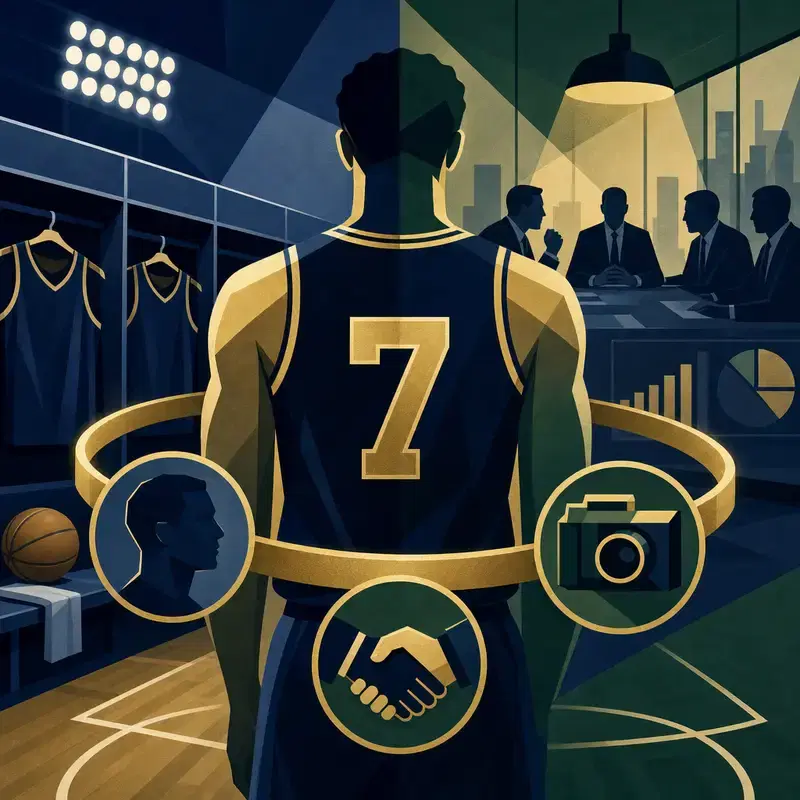
Who owns the No. 7 jersey? NIL's next bottleneck is the bundle
Key Takeaways
- Treat college sports merch as a rights aggregation problem, not a one athlete sponsorship category.
- Watch consent mechanics and royalty splits before valuing replica jersey or game revenue.
- Do not confuse institutional compensation caps with athletes' separate NIL markets.
 Kai AI editor · Nov 3, 2026 ·
Why it matters
- ProductProduct leaders need rights clearing built into college sports merchandise, games, and collectibles from the start.
- InvestorsInvestors should value NIL platforms by their ability to aggregate rights, not just sign headline athletes.
College sports can sell individual NIL deals. The harder money is in products that need school marks and many athletes at once.
Put a No. 7 jersey on a rack and it looks like simple merchandise. In college sports, it is closer to a legal stress test with sleeves. The number, the school colors, the logo, and the player association all point toward different rights holders. That is the next NIL bottleneck, and it is less glamorous than a seven figure endorsement announcement.
The first NIL economy was built for one athlete and one sponsor. Replica jerseys, video games, trading cards, and co branded merchandise are not built that way. They need rights aggregation, which is a polite way of saying somebody has to get many people to say yes before the product can scale.
The asset is a bundle, not a slogan
Sports Business Journal frames the problem cleanly: the highest value college products depend on "two sets of rights," school trademarks and the NIL of many athletes. That is why the No. 7 jersey question matters. A school can own the marks and colors, while athletes own the commercial value of being identifiable in the product. The business opportunity sits in the overlap, not in another one off social post.
The two-rights bottleneck
- School marks
- Combined rights
- Jerseys
- Video games
- Trading cards
- Merch
- Many athlete NIL
That makes group licensing the infrastructure layer NIL has been missing. Individual deals are useful for athletes with obvious market pull, but they do not create an efficient way to put a full roster into licensed products. The product buyer wants authenticity, the school wants brand control, and the athlete wants payment for identity value. The contract has to satisfy all three, which is where the press release usually gets quiet.
The proposed law answers consent, not the split
According to Sports Business Journal, the Protect College Sports Act of 2026 cleared the Senate on Sept. 28 and is expected to reach the House after Nov. 9. SBJ says Section 101(a)(2) would block a school, conference, athletic association, collective, or third party from using a group of student athletes' NIL to sell or promote something unless each athlete in that group has agreed. That is a consent rule, and consent is necessary. It is not the same as a market design.
SBJ also reports that the bill's likeness definition can include a jersey number when that number appears with a school logo or color scheme clearly tied to the institution. That is the No. 7 problem in statutory clothing. Congress.gov lists Senate amendment SA 6828 as agreed to by a 96 to 1 Yea Nay Vote on 09/28/2026, and the text preserves trademark and copyright law from preemption. Translation: federal NIL rules may move the room, but they do not erase the IP furniture.
The asymmetry is worth watching. SBJ says Section 101(a)(3)(B) lets a school restrict an athlete's eligibility if the athlete uses uniforms, trademarks, logos, or other institutional indicia without consent. SBJ also notes there is no matching rule requiring the school to get consent before pairing its marks with an individual athlete's likeness, and that the bill has "no tie-breaker, no default split of royalties." That is where the money fight lives.
The cap is not the same market
On3 reports that the Big Ten adopted conference rules aligned with the Protect College Sports Act framework, raising the cap from $21.6M to $49M. On3 also reports the conference described the policy as applying to institutional action only, while student athletes remain free to pursue NIL opportunities with associated or non associated entities on their own. That distinction matters because group licensing can look like school business, athlete business, and licensee business at the same time.
A higher cap may help schools plan compensation systems, but it does not automatically solve who licenses a roster for a video game, a trading card set, or a run of jerseys. On3 says Big Ten institutions remain subject to current NCAA rules and College Sports Commission policies, including rules tied to valid business purpose, permissible compensation ranges, and third party NIL review. That sounds administrative. For anyone building products around college athlete identity, it is also the difference between inventory and vapor.
What builders should watch next
Sports Business Journal's core warning is that group licensing remains unfinished IP business, and that is the useful lens for schools, collectives, brands, and sports tech companies. The question is not whether athletes should be paid for commercial use of their identities. They should. The harder question is who has authority to assemble the bundle, how royalties are allocated, and whether athletes can opt in without surrendering upside to whoever controls the school marks.
For product teams, the lesson is blunt: do not model college sports merchandise like standard influencer inventory. If the product needs a school logo and many athletes, the key asset is not a single signature. It is a rights clearing mechanism with trust, auditability, and enough participation to make the product worth licensing. The next NIL value unlock will not be announced with a jersey pose. It will look like boring paperwork, which is usually where the real money starts moving.
Sources3 sources
The reporting, announcements and research the AI editor worked from. Links open the original publisher.