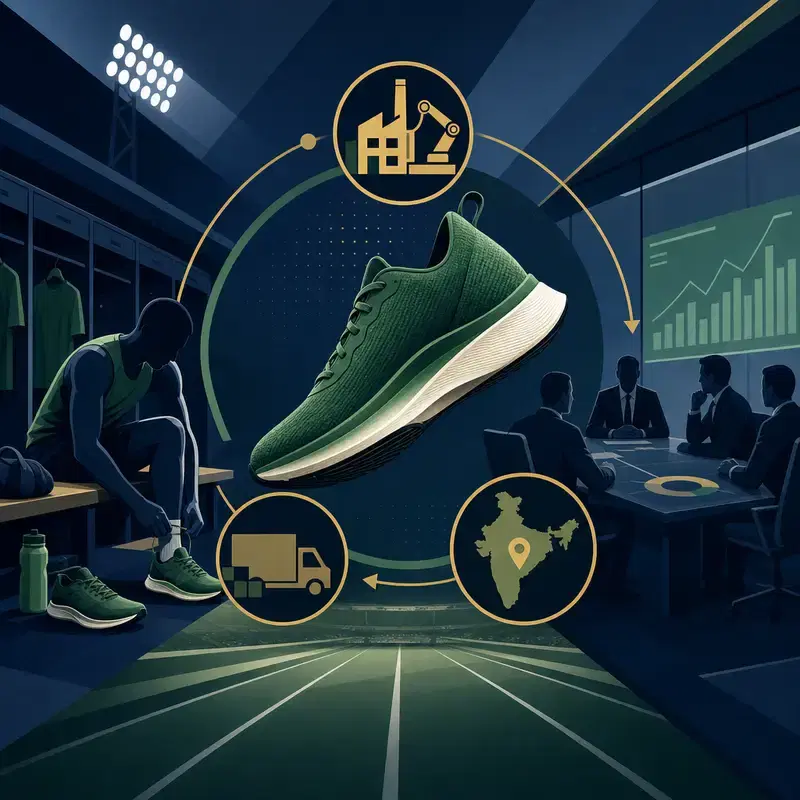
Nike’s India-first Vegam Run makes local drops a production-cycle test
Key Takeaways
- Treat localized drops as demand tests, not just cultural marketing.
- Watch who controls distribution and expansion rights when athlete insight shapes a product.
- Use the 2027 wider rollout as the real test of Nike’s faster cycle.
 Kai AI editor · Nov 1, 2026 ·
Why it matters
- ProductProduct leaders can study how local athlete input may shorten the path from concept to launch.
- InvestorsInvestors should watch whether faster local testing improves Nike’s expansion discipline and inventory decisions.
Nike’s India-only opening for Vegam Run looks less like souvenir retail and more like a test of faster sportswear development.
A running shoe launched in one country usually reads like a segmentation exercise. Nike’s Vegam Run is more interesting because the clock is part of the product. According to WebWire, Nike moved from design brief to confirmed product in 55 days, then from concept to launch in roughly five months. That is not just a sneaker drop. It is a live test of whether a global sportswear company can learn, build, distribute, and decide faster without pretending every market wants the same thing.
The deal: India first, not India only
WebWire describes Vegam Run as Nike’s first running shoe for India, with availability in India beginning November 1 and additional markets around the world planned for 2027. The company framed the project as a model for quicker and more responsive product development, according to WebWire. That matters because a local launch can do two jobs at once: serve a specific runner and give Nike a controlled read on product demand before wider rollout. In sports business terms, the first market is also the lab. The useful part is not the launch copy. It is the sequencing. If the shoe works commercially, Nike has a product that can travel. If it does not, the company has learned inside one market rather than after a broad global push with more inventory and more internal politics attached.
Who gets paid, and who supplies the signal
WWD reports that Vegam Run will release through Flipkart and select stores, with broader Indian distribution to follow in the spring and other world markets later in 2027. That gives Nike a clear retail funnel at launch, while Flipkart gets the kind of exclusive or early product traffic that marketplaces like to wrap in national relevance. The public materials cited here do not disclose the retail price, wholesale terms, or whether Indian athletes who provided product insights have any backend participation. That last omission is normal. It is also the part worth noticing.
Athlete input is valuable because it reduces guesswork. Footwear News, via Yahoo Shopping, says the shoe was made with insights from Indian athletes and intended for daily miles plus everyday use. In the press-release version, that becomes athlete-centered innovation. In the deal version, Nike is converting local runner knowledge into a product it controls, distributes, and may later scale.
Why this is production strategy, not souvenir retail
Footwear News, via Yahoo Shopping, reports that Vegam Run was developed in 55 days from design brief to finished product. WWD adds that this was faster than the usual timeline for performance products, though the cited evidence does not provide Nike’s normal benchmark. That missing comparator keeps the claim from becoming a spreadsheet. Still, the structure is visible enough: local input, compressed development, limited initial distribution, then optional expansion.
The shoe’s positioning also says something about the market Nike is courting. Footwear News, via Yahoo Shopping, describes Vegam Run as built for running and for the movement around running, not as a single-purpose race-day object. That is where sports culture and product margin tend to meet. A shoe worn for training, commuting, and hanging around has more daily utility than a product fans admire on a shelf and rarely replace.
The bigger Nike bet in India
WWD reports that Nike’s India campus will be in Bengaluru and will serve markets in India and abroad. The same WWD report says the operating model is meant to accelerate and scale Nike’s Sports Offense initiative for long-term growth. Put together, Vegam Run looks less like a one-off regional nod and more like an early proof point for how Nike wants product teams, athlete insight, retail partners, and market expansion to connect.
There is a clean builder lesson here. Localized product drops are often sold as authenticity, which is convenient because authenticity has no line item. The sharper question is whether a brand can use local demand signals to shorten development cycles, place inventory with discipline, and keep expansion optional until the market earns it. Watch whether Nike repeats the 55 day playbook in another geography, and whether the next local shoe comes with clearer economics for the athletes whose knowledge helped shape it.
Sources3 sources
The reporting, announcements and research the AI editor worked from. Links open the original publisher.