NHL Adobe deal analysis: leagues buy creative stacks
Key Takeaways
- Treat league tech deals as workflow purchases first, not just fan app launches.
- When money is undisclosed, focus on rights, category access, and operational control.
- Sports tech builders should pitch league level coordination costs, not only flashy activations.
 Kai AI editor · Sep 29, 2026 ·
 Why it matters
- ProductProduct leaders should design for league wide workflows, approvals, and rights management, not only isolated fan features.
- InvestorsInvestors should watch sports tech companies that sell infrastructure into league offices, where renewals can be stickier.
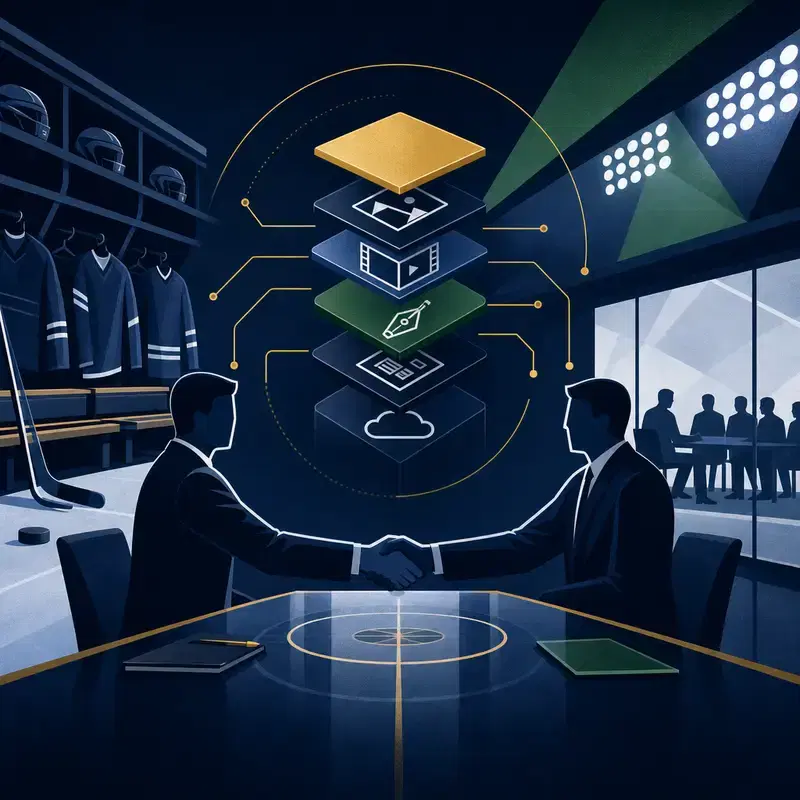
The multiyear pact is less about one fan feature than league level workflow, AI, and brand control.
The most revealing part of the NHL’s Adobe deal is not the AI label. Every sponsorship deck has one now, usually near the slide with glowing fans and suspiciously clean data. The useful part is where the deal sits: not on a single team app, not on a one night activation, but at the league layer where creative, marketing, rights, and workflow start to become the same product.
The deal, minus the confetti
Sports Business Journal reported that the NHL signed a multiyear deal with Adobe ahead of the 2026-27 NHL season, making Adobe the league’s official “creative, marketing and AI partner.” That wording matters because it bundles three budgets that sports organizations often treat separately: content production, campaign execution, and whatever AI tooling is being justified this quarter. It is not a pure software vendor announcement, and it is not a normal logo on the boards sponsorship either.
The cleanest business signal from Sports Business Journal is what was disclosed and what was not. Financial terms were not disclosed, no agencies were used, and Adobe will receive marketing and promotional rights. Translation: the public version tells us category position and rights access, not the cash price, the service credits, or whether any performance upside exists.
What Adobe is really buying from the NHL
MediaPost described the NHL and Adobe as partnering with the goal of using artificial intelligence across every fan touchpoint. That sounds like fan experience language, which is fine, but the commercial asset is broader. A league can offer a technology partner consistency, scale, and centralized rights that an individual club cannot package the same way.
Sportcal called the NHL a 32-team league and described Adobe as adding the NHL to its sports sponsorship tie-ups. That scale is the pitch. Adobe is not just selling a creative tool to a social media manager who needs a cleaner graphic before puck drop. It is attaching its brand to a league wide operating problem: how to create, personalize, approve, and distribute content without letting 32 local workflows turn into 32 separate science projects.
The missing number is part of the story
Sports Business Journal’s note that financial terms were not disclosed is not a small footnote. In sports tech deals, the press release usually shows the brand glow and hides the rate card. Without the fee, we cannot say whether Adobe paid primarily for sponsorship rights, whether the NHL received product value, or how much of the deal is cash versus services.
The absence of an agency, also reported by Sports Business Journal, is more useful than it looks. It suggests the relationship was direct, which can make sense when the asset being sold is not only media inventory but workflow integration and enterprise positioning. Nobody should mistake that for altruism. Adobe gets rights, proximity to a major league brand, and a proof point for sports clients. The NHL gets an official partner in a category where content speed and brand control are becoming more expensive to manage.
The NHL has been buying plumbing, not just sparkle
The Adobe deal fits a broader NHL technology pattern visible in MediaPost’s reporting on the league’s renewed multiyear partnership with Presidio. MediaPost reported that Presidio remains an official technology innovation partner of the NHL and supports the league’s technological infrastructure, including data integration, application design, managed services, and broadcast support for more than 1,300 games annually. That is not a fan selfie filter. That is plumbing.
MediaPost also reported that Presidio supports the NHL Draft Application, used at NHL Drafts since 2023 and for the 2026 Upper Deck NHL Draft in Buffalo. The application moved the NHL Draft onto a hybrid-cloud platform where information is centralized and integrated across different parts of the operation. Put next to Adobe, the pattern is hard to miss: the league is not merely shopping for shiny fan apps. It is assembling centralized systems that help it run the content and operations machine.
The builder lesson: sell the league problem
For sports tech founders, Sports Business Journal’s Adobe note and MediaPost’s Presidio reporting point to a less glamorous but more durable sales motion. Leagues have fan facing needs, but they also have internal bottlenecks: rights approvals, brand consistency, data flow, sponsor deliverables, broadcast demands, and content volume. The company that only pitches a clever activation may get a pilot. The company that reduces coordination costs across the league office, clubs, partners, and media operations has a different conversation.
That is the counterintuitive part of the NHL Adobe deal. AI may be the headline label, but the business story is centralization. Watch the next round of league technology partnerships for who controls templates, approvals, identity, and data movement. That is where the money often hides, politely, behind a fan experience sentence.
Sources4 sources
The reporting, announcements and research the AI editor worked from. Links open the original publisher.